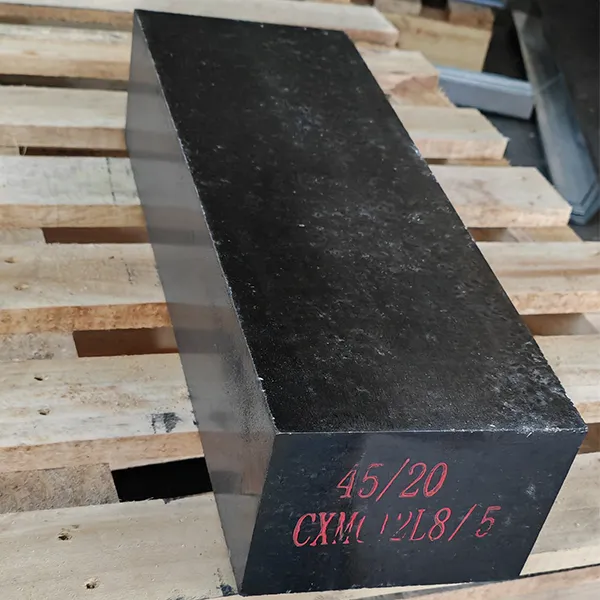
Magnesia-carbon bricks are composite materials of magnesia and carbon. Graphite is key to inhibiting slag penetration and resisting erosion, while resin-carbon provides structural strength. However, both resin-carbon and graphite are prone to oxidation. Therefore, anti-oxidants have been a hot research topic since the advent of magnesia-carbon bricks.
There are two main pathways for carbon oxidation in magnesia-carbon bricks: one is the oxidation of carbon by gaseous components, and the other is the oxidation by oxidizing components in the slag or steel. The oxidizing components in the slag or steel are mainly (FexO) and [O], etc. This oxidation occurs accompanied by the infiltration of the corresponding liquid phase into the magnesia-carbon brick, as shown in equations (1) and (2):
FexO+C→Fe+CO(1)
MnO+C→Mn+CO(2)
Antioxidants prevent the oxidation of graphite by both gas and liquid phases. Currently, antioxidants used in magnesia-carbon bricks are mainly of metallic and non-metallic types. Metallic antioxidants primarily include Al, Si, and Al-Mg, while non-metallic antioxidants mainly include B4C, ZrB2, and SiC.
Among metallic antioxidants, Al powder is the most widely used. At high temperatures, it first reacts with carbon to form Al4C3, which then reacts with CO(g) and other components. The specific mechanism of action is as follows:
4Al+3C=Al4C3 (3)
2Al+3CO=Al2O3+3C (4)
Al4C3+6CO=2Al2O3+9C (5)
Al2O3+MgO=MgO·Al2O3(6)
With the participation of metallic Al or Al4C3 in the reaction, the oxygen partial pressure in the brick decreases, protecting graphite and other materials. The anti-oxidation mechanism of metallic Si is similar.
Metallic Al exhibits good anti-oxidation effects, mainly due to two factors: firstly, the reduction of oxygen partial pressure in magnesia-carbon bricks by equations (3)~(4); secondly, the volume expansion effect of the reaction in equation (6) densifies the structure of magnesia-carbon bricks. Simultaneously, equations (3) and (6) contribute to the high high-temperature flexural strength of magnesia-carbon bricks, which is why metallic Al powder is often used as an anti-oxidant in magnesia-carbon bricks. However, due to the significant volume effect associated with reaction (3), the amount of metallic Al added to magnesia-carbon bricks is generally below 3%. Metallic Si exhibits a relatively small volume effect during the anti-oxidation process, but the high-temperature performance of the material is reduced due to the formation of M2S (2MgO·SiO2) from the oxidation of SiO2.
Besides reacting with carbon to form SiC, metallic silicon (Si) powder can also form whisker-like SiC fibers, thereby enhancing strength. Therefore, as an antioxidant in magnesia-carbon bricks, it is generally a composite of metallic Al (Al) powder and Si powder. In the design of novel magnesia-carbon bricks for slag lines, adding metallic Al and Si powder separately as antioxidants results in a longer service life than traditional magnesia-carbon bricks for slag lines. The microstructure of magnesia-carbon bricks with added Al and Si is observed and discussed, along with thermodynamic analysis of the antioxidant mechanism.
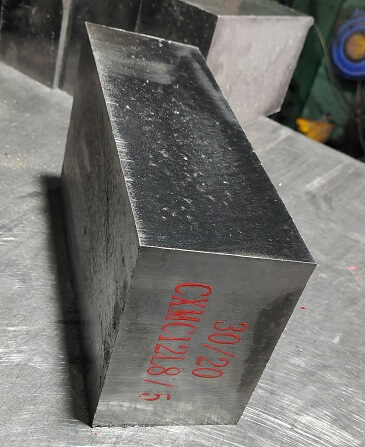
Regarding other metallic antioxidants, Mg-Al alloys are commonly used. Zhang Jin and Zhu Boquan added Mg-Al alloy powder as an antioxidant to low-carbon magnesia-carbon bricks. The mechanism of action of Mg-Al alloy is similar to that of Al, while Mg also accelerates the formation of the secondary periclase layer, significantly improving the antioxidant properties of the magnesia-carbon bricks.
Compared to metallic antioxidants, there has been more research on non-metallic antioxidants in recent years, which have also shown very good antioxidant performance. Non-metallic antioxidants mainly include B4C, ZrB2, MgB2, TiN, and SiC, but SiC is relatively less effective than other antioxidants. Non-metallic antioxidants (taking B4C and ZrB2 as examples) will undergo the following reaction in magnesia-carbon bricks:
B4C+6CO=2B2O3+7C (7)
ZrB2+5CO=ZrO2+B2O3+5C (8)
The B₂O₃ generated in the reaction reacts with MgO and other substances to form a sealing layer, thereby preventing further oxidation of the magnesia-carbon bricks.
By measuring the functional relationship between carbon mass loss and temperature (1300 and 1500℃) and time (2, 4, and 6 h), the oxidation resistance of MgO-C refractory samples with added antioxidants (Al, Si, SiC, and B₄C) at mass fractions of 0%, 1%, and 3% was compared. It was concluded that at 1300℃ and 1500℃, B₄C was the most effective antioxidant, especially at 1500℃, where its effect was significantly better than the other three. This is because it forms an impermeable, dense Mg₃B₂O₆ layer on the brick surface. Although SiC can also improve the oxidation resistance of magnesia-carbon bricks, its effect is relatively weaker. Thermogravimetric analysis and X-ray diffraction confirmed that B₄C oxidizes during firing below 1000℃, yielding 3MgO·B₂O₃, which is stable at high temperatures.
MgB2 and other antioxidants were applied to magnesia-carbon refractories, and calcined under both carbonized and air atmospheres. The results showed that the antioxidant effect was second only to B4C, but superior to Al powder and Si powder. Furthermore, it was indicated that the optimal mass fraction of MgB2 in magnesia-carbon refractories is approximately 3%. Two types of magnesia-carbon brick samples were prepared: one without additives and the other with 2% carbon-containing TiN. Slag erosion resistance tests showed that the sample with added TiN exhibited significantly better slag erosion resistance than the sample without additives. The main reason why TiN improves the slag erosion resistance of magnesia-carbon bricks is that TiO2, the oxidation product of TiN in the reaction layer, reacts with CaO in the slag to form CaTiO3 with a melting point of 1970℃; TiO2 formed after TiN oxidation in the decarburized layer reacts with C, CaO, and MgO to form CaTiO3 and 2MgO. TiO2, TiC, and Ti(C,N) solid solutions are all high-melting-point mineral phases, increasing the viscosity of the slag and reducing its penetration, thereby improving the slag erosion resistance of the magnesia-carbon bricks. Furthermore, when TiN (mass fraction, 2%), aluminum powder (mass fraction, 1%), and B4C (mass fraction, 0.5%) are used in combination, the high-temperature flexural strength, oxidation resistance, and slag erosion resistance of magnesia-carbon bricks are significantly improved.
In recent years, the antioxidants used in magnesia-carbon bricks have increasingly favored composites of metallic and non-metallic compounds. This addresses the issue of poor antioxidant performance of single antioxidants within a specific temperature range, allowing each antioxidant to leverage its own performance advantages. Combining metallic antioxidants with B4C or MgB2 improves both antioxidant resistance and resistance to slag erosion.
Different combinations of Al, Si, SiC, and B4C as antioxidants were tested. Samples were held at 1400℃ for 2 hours. Analysis showed that the Al-Si composite antioxidant performed best. At high temperatures, SiC is oxidized after C, while B4C oxidizes before C, and its oxidation product, B2O3, is a liquid phase, which helps to block material pores. However, B2O3 has a melting point of only 450℃, causing its evaporation rate to gradually accelerate, ultimately reducing the antioxidant performance of B4C-containing materials. In low-carbon magnesia-carbon bricks, 3% Al and 1% TiO2 were introduced as additives. The bricks were then subjected to carbon-embedded heat treatment at 1000℃ and 1300℃, and four groups were compared: no antioxidant, 3% Al alone, 1% TiO2 alone, and a combination of 3% Al and 1% TiO2. The results showed that the combined introduction of Al and TiO2 additives avoided the formation of Al₄C₃, which helped improve the hydration problem of Al powder alone after carbon embedding treatment in magnesia-carbon bricks. This resulted in the highest compressive strength and the smallest oxide layer thickness among the four groups.
Regarding antioxidants, although research has been conducted for many years, antioxidants remain a major research direction for magnesia-carbon bricks.