
By utilizing a medium-frequency induction furnace to melt gray cast iron, and through the selection and quality control of raw materials, optimization of charge composition, and refinement of inoculation and alloying processes, a smelting process for high-strength gray cast iron in a medium-frequency induction furnace was established. The key technical characteristics of this smelting process were summarized.
1. Chemical Composition and Ingredients
1. Determination of Chemical Composition
The microstructure determines the various properties of gray cast iron, and changes in chemical composition can alter the microstructure; therefore, selecting an appropriate chemical composition is one of the ways to improve the properties of gray cast iron. The chemical composition of gray cast iron must be selected appropriately based on the wall thickness and technical requirements of the castings being produced.
Traditional methods suggest that to increase the strength of gray cast iron, one must reduce the carbon equivalent or increase the manganese content to raise the proportion of pearlite in the alloy, thereby enhancing the strength of the castings. However, the method of reducing the carbon equivalent to increase strength introduces many disadvantages, such as deteriorated casting processability and an increased tendency toward white cast iron. In particular, for thin-walled parts, this may lead to poor machinability; consequently, this approach has not been widely adopted.
Currently, the widely adopted approach is to use the highest possible carbon equivalent while ensuring high strength. Increasing the carbon equivalent can significantly improve the casting performance of gray cast iron, reducing shrinkage cavities and porosity, and lowering the casting scrap rate. Since the thinnest sections of the produced castings are 5–6 mm, the carbon equivalent of the original molten iron is controlled at 3.8%–3.95%; Understanding of the role of sulfur in gray cast iron has evolved gradually. Initially viewed as a harmful element, it was later recognized that adding a certain amount of sulfur improves inoculation effects and graphite morphology, thereby enhancing machinability. This led to the gradual realization that sulfur content within a specific range is beneficial for gray cast iron. We determined the chemical composition of the original molten iron based on the structural characteristics of the castings being produced, as shown in Table 1.
The chemical composition of the original molten iron is primarily ensured through material selection and control of the smelting process, while the chemical composition of the castings is controlled through inoculation and alloying during the pre-furnace treatment process.
2. Determination of Charging Composition
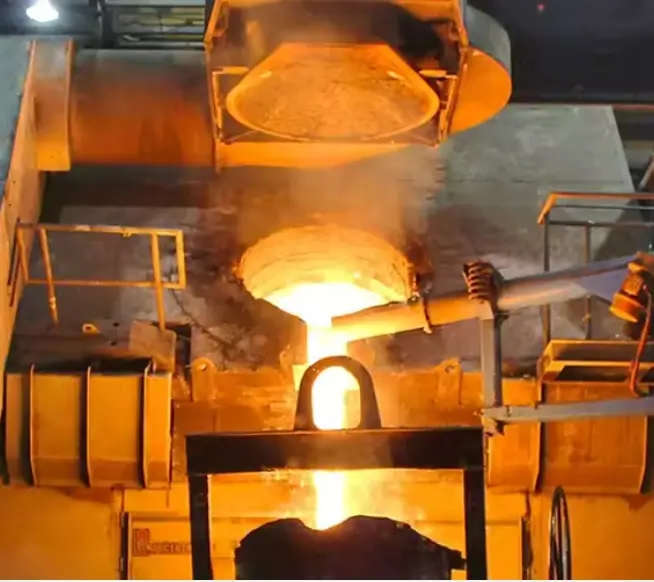
In the cupola smelting process, the addition of large amounts of scrap steel aims to reduce the carbon equivalent of the molten iron. The use of incandescent coke to increase carbon content satisfies the required chemical composition while improving molten iron quality. This is because carbon diffusing into the molten iron from coke yields a higher quality product than that obtained directly from melting raw materials; it minimizes the hereditary characteristics of the pig iron, which is more conducive to improving molten iron quality. In contrast, electric furnace smelting involves directly adding raw materials to the furnace for melting, which is fundamentally different from the cupola smelting principle. To ensure molten iron quality, scrap steel and return scrap are used for charging instead of pig iron. The process employs carbon-increasing agents to produce cast iron, which not only eliminates the inherent properties of pig iron but also enhances the mechanical properties of the cast iron, such as toughness and strength. Additionally, this process reduces casting shrinkage, significantly decreasing defects in this area, thereby combining the strengths of both electric furnace and cupola smelting. Furthermore, castings produced using this molten iron yield excellent graphite morphology.
2. Feeding Process
The carbon additive is added using the “add-with-charge” method, which involves adding it to the furnace as the iron charge is continuously fed in. The timing of addition has a significant impact on carbon absorption during the melting process. If the carbon additive is added too early, it tends to adhere to the furnace bottom, especially when there is no molten iron in the furnace yet. If the carbon additive is added to the furnace at this stage, as melting progresses and the iron gradually enters the molten state, the carbon additive may come into contact with oxygen in the air and reach its ignition point, leading to combustion. This not only wastes the carbon additive but also makes it difficult for the carbon additive adhering to the furnace walls to be incorporated into the molten iron. Conversely, if the addition is too late, the optimal window for carbon enrichment is missed, leading to delays in smelting and temperature rise. This not only postpones the timing for chemical composition analysis and adjustment but may also result in hazards caused by excessive heating. Therefore, it is advisable to add the carbon additive in batches during the process of charging the furnace with metal feedstock.
Based on the above analysis, the timing for adding the carbon additive is determined as follows: When the total iron charge in the furnace reaches approximately 5.5 tons, a certain amount of molten iron is already present. At this point, begin adding the carbon additive, dividing the total amount for each batch into 3 to 4 equal portions. Add one portion of the carbon additive for every 1 to 2 tons of iron added, and ensure that all the carbon additive is fully added to the furnace by the time the total iron charge reaches 9 tons. This addition method fully utilizes the electromagnetic stirring effect of the medium-frequency electric furnace, which facilitates carbon dissolution and diffusion while preventing the carbon additive from floating on the surface of the molten iron and being lost due to burning. Before the carbon additive is completely dissolved, the prolonged stirring time ensures a high absorption rate, thereby minimizing loss due to burning and improving the utilization efficiency of the carbon additive.
The chemical composition of the molten iron has a certain influence on the absorption rate of the carbon-increasing agent. When the initial carbon content in the molten iron is high, within a certain melting limit, the absorption rate of the carbon-increasing agent is slow, the absorption amount is low, and the loss due to burning is relatively high, resulting in a low absorption rate. When the initial carbon content in the molten iron is low, the situation is reversed. Therefore, when selecting a method for adding the carbon-increasing agent, the method of adding in batches as the furnace progresses should be adopted; the silicon content in the molten iron has a significant impact on the carbon-increasing effect. Molten iron with high silicon content has poor carbon-increasing properties. As shown in Figure 2, the absorption efficiency of carbon-increasing agents varies significantly over different time periods in molten iron with varying silicon contents. Under the same time conditions, the absorption efficiency of carbon-increasing agents in molten iron with higher silicon content is significantly lower than that in molten iron with lower silicon content. This is particularly true during electric furnace smelting, which follows the principle of “rapid melting.” Consequently, if the carbon-increasing agent does not have sufficient time to melt and be absorbed within a short period, severe burn-off may occur, resulting in a low absorption rate.
Just as the silicon content in molten iron affects carbon addition, sulfur content also has a certain influence on the process. Using the same carbon-increasing agent, iron sulfide was added for sulfur enrichment prior to introducing the agent into the electric furnace to observe the effect of sulfur content on carbon addition. When the molten iron contains 0.05% w/w sulfur (wS), the carbon addition rate is significantly slower compared to low-sulfur molten iron (0.015% w/w S) that has not been treated with iron sulfide.
Silicon and sulfur in molten iron hinder carbon absorption and reduce the absorption rate of carbon-increasing agents, whereas manganese promotes carbon absorption and enhances the absorption rate of carbon-increasing agents. In terms of the degree of influence, silicon has the greatest effect, followed by manganese, while sulfur has a relatively minor impact. Therefore, in actual production processes, manganese should be added first, followed by carbon, and then silicon and sulfur.
3. High-temperature refining process
The maximum melting temperature of molten iron has a significant impact on various properties of cast iron. Within a certain range, increasing the superheat of the molten iron and maintaining it for a specific duration allows any residual undissolved graphite particles to be completely dissolved into the molten iron. This eliminates the hereditary effects of various materials, fully utilizes the inoculation effect of inoculants, and enhances the molten iron’s inoculation capacity.
Theoretically, coarse hypereutectic graphite can be melted to below the critical crystallization radius when the molten iron temperature reaches 1500°C and is maintained for 6–9 seconds. Only under such smelting conditions can the quality and performance of high-grade inoculated cast iron or ductile iron be reliably ensured. Therefore, after the iron charge has been fully melted into molten iron and the slag has been skimmed off, the temperature is raised to above 1500°C to melt the graphite below the critical crystallization radius. At this temperature, oxide inclusions and porosity in the molten iron are minimized, sulfur enrichment is suppressed, graphite heredity is eliminated, and the chemical composition is stabilized. Excessively high smelting temperatures will increase the crystallization undercooling of the molten iron, which is detrimental to service performance. We have set the high-temperature holding process temperature at 1520°C, with a holding time of 8 to 12 minutes.
4. Front-of-furnace treatment process
Combining high-quality molten iron with effective inoculation is an effective method for producing high-performance castings. Effective inoculation not only refines the matrix structure and alters graphite morphology but also reduces the tendency toward white cast iron and improves machinability. The primary objectives of inoculation treatment are to promote graphitization, reduce the tendency toward white cast iron, increase the number of eutectic clusters, control graphite morphology to obtain Type A graphite, and improve the properties of gray cast iron.
The selection of inoculants is particularly important. In addition to their notable graphitization capability, ease of producing Type A graphite, refinement of the eutectic cluster structure, and high mechanical properties, Ba-containing inoculants have another prominent feature: their strong resistance to degradation. The long-lasting effect of Ba-containing inoculants is primarily due to Ba inhibiting the diffusion of C and Si in the iron, thereby providing a favorable environment for the formation and growth of graphite nuclei. When a certain amount of barium and calcium is added to silicon-barium inoculants, it enhances the nucleation capacity of the molten iron, facilitating the formation of fine, dispersed graphite and appropriately increasing the number of eutectic clusters, thereby improving the mechanical properties of the castings. Long-term production practice has demonstrated that the barium content in silicon-barium inoculants has a certain influence on inoculation decay during the cooling process of castings, with this effect being particularly pronounced in large castings. Therefore, we have selected a silicon-barium inoculant containing 3% to 5% barium.
1. Alloying Process
The primary objective of alloying gray cast iron is to strengthen and refine the matrix by adding a certain amount of alloying elements to the molten iron, thereby improving the matrix strength. For high-strength gray cast iron, the goal is to increase the pearlite content in the matrix and refine the pearlite structure.
The primary role of alloying elements in gray cast iron is to enhance the strength of the casting, which is manifested in the following ways: ① Refining graphite and eutectic clusters; ② Increasing the pearlite content in the matrix and reducing the interlamellar spacing of pearlite; ③ Improving the thermal stability of cementite. ④ Forming hardening phases such as carbides or phosphide eutectics containing alloying elements.
However, when adding alloying elements, one must consider both their impact on performance and economic feasibility. While some precious metals (such as nickel) significantly improve the mechanical properties of castings, they are expensive and increase casting costs; therefore, they are generally not used. The alloys added by our company include copper, tin, and ferromolybdenum.
2. Method of Adding Furnace-Front Treatment Materials
Inoculants are generally added at the tap hole, where they slowly enter the ladle with the molten iron. Alloy materials can be added directly into the ladle, and efforts are made to ensure uniform distribution through the action of the molten iron’s flow and stirring. In practice, the addition of pre-ladle treatment materials begins when the molten iron in the ladle reaches approximately 20% of its capacity and is completed by the time the molten iron reaches 80% of the ladle’s capacity. This ensures that the pre-ladle treatment materials are fully and uniformly melted into the molten iron within the ladle, resulting in a homogeneous composition throughout the entire batch of molten iron, which in turn ensures a consistent microstructure in the castings.
5.Conclusion
Castings such as cylinder blocks, cylinder heads, and crankcases produced using this melting process—specifically grades HT250 and HT280—meet all process requirements for physical and chemical properties, while also improving machinability. The key control points for this process are as follows:
(1) Determining appropriate chemical compositions and charge ratios is a prerequisite for obtaining high-quality molten iron and producing high-performance gray cast iron components.
(2) Selecting appropriate raw materials and strengthening the management and control of raw material quality—particularly the management of critical furnace charges such as carbon additives—reduces the impact of trace elements on casting quality.
(3) Rationally selecting the electric furnace melting power based on the smelting process, as well as the method and timing of adding various furnace charges, and process parameters such as high-temperature holding temperature and duration, are crucial steps in obtaining high-quality molten iron.
(4) Selecting silicon-barium inoculants that prolong inoculation effects and enhance nucleation capacity, along with alloying processes involving copper, tin, and chromium, and employing appropriate material addition methods can refine the matrix structure, alter graphite morphology, reduce the tendency toward white cast iron, and improve machinability.
