
High-alumina bricks are primarily classified into the following types: standard high-alumina bricks, high-load-bearing soft high-alumina bricks, low-creep high-alumina bricks, phosphate-bonded high-alumina bricks, and micro-expanding high-alumina bricks.
1. Standard high-alumina bricks:
The primary mineral composition of ordinary high-alumina bricks consists of mullite, corundum, and a glass phase. As the Al₂O₃ content in the product increases, the proportions of mullite and corundum also rise, while the glass phase correspondingly decreases, thereby improving the product’s refractoriness and high-temperature performance. Ordinary high-alumina bricks possess a range of refractory properties superior to those of clay bricks. They are a highly effective and widely used material, extensively applied in various thermal furnaces and kilns. Compared to clay bricks, they can effectively extend the service life of furnaces and kilns.
2. High-load, soft, high-alumina bricks:
Compared to ordinary high-alumina bricks, high-load-softening high-alumina bricks differ in their matrix and binder components: In addition to adding mullite concentrate to the matrix, high-alumina materials such as corundum powder and high-alumina corundum powder are appropriately incorporated to ensure that the post-firing chemical composition closely matches the theoretical composition of mullite; for the binder, high-quality ball clay is selected, and depending on the specific type, either a composite clay binder or a mullite binder is used. Through these methods, the load-softening temperature of the high-alumina bricks can be increased by approximately 50–70°C.
3. Low-creep high-alumina bricks:
The creep resistance of high-alumina bricks is enhanced through so-called unbalanced reactions. Specifically, based on the operating temperature of the furnace, minerals such as tri-silicate and activated alumina are added to the matrix to bring its composition close to or entirely consistent with that of mullite. Since the mullitization of the matrix inevitably increases the material’s mullite content and reduces the glass phase content, and given that mullite’s excellent mechanical and thermal properties contribute to improved high-temperature performance. To achieve complete mullitization of the matrix, controlling the Al₂O₃/SiO₂ ratio is critical. Low-creep high-alumina bricks are widely used in thermal furnaces such as hot blast stoves and blast furnaces.
4. Phosphate-bonded high-alumina bricks:
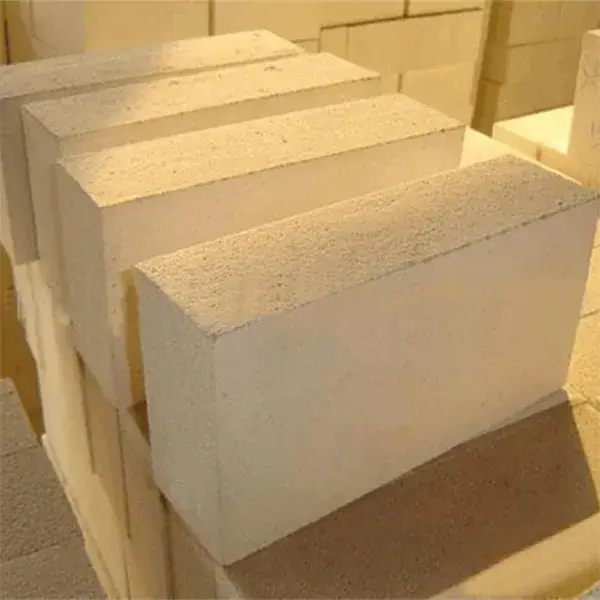
Phosphate-bonded high-alumina bricks are chemically bonded refractory bricks manufactured using dense, premium-grade or first-grade high-alumina bauxite clinker as the primary raw material, with phosphate or aluminum phosphate solutions as binders. They are formed by semi-dry mechanical pressing and then heat-treated at 400–600°C. As these are unfired bricks, to prevent excessive shrinkage during use, the formulation typically includes heat-expanding materials such as mullite and silica. Compared to ceramic-bonded, fired high-alumina bricks, these bricks exhibit superior resistance to spalling; however, they have a lower load-softening temperature and poorer resistance to erosion. Therefore, small amounts of fused alumina and mullite are added to strengthen the matrix. Phosphate-bonded high-alumina bricks are widely used in kiln components such as cement rotary kilns and electric furnace roofs.
5. Slightly Expanding High-Alumina Bricks:
This brick is primarily made from high-alumina bauxite as the main raw material, with the addition of tricalcium silicate concentrate, and is manufactured according to the production process for high-alumina bricks. To ensure that the high-alumina brick expands appropriately during use, the key lies in selecting the appropriate tricalcium silicate concentrate and its particle size, as well as controlling the firing temperature. This ensures that a portion of the selected tricalcium silicate undergoes mullitization, while the remaining portion retains its original form. During use, the residual tricalcium silicate undergoes further mullitization (primary or secondary mullitization), accompanied by volumetric expansion. It is preferable to use a composite material for the selected tricalcium silicate, as the decomposition temperatures of different tricalcium silicate minerals vary, and the expansion resulting from mullitization varies accordingly. By leveraging this characteristic, high-alumina bricks exhibit expansion effects corresponding to different operating temperatures, which compress the brick joints, enhancing the overall density of the lining and thereby improving the bricks’ resistance to slag penetration.
Main applications of high-alumina bricks:
High-alumina bricks are primarily used for lining blast furnaces, hot blast stoves, electric furnace roofs, blast furnaces, reverberatory furnaces, and rotary kilns. In addition, high-alumina bricks are widely used as checker bricks in open-hearth furnaces with regenerative systems, as well as for plugs and nozzle bricks in casting systems. However, since high-alumina bricks are more expensive than clay bricks, there is no need to use high-alumina bricks in applications where clay bricks can meet the requirements.
