
Currently, the main structures of gas-permeable bricks include the diffuse type, the straight-channel directional type, and the slit-type directional design, as shown in Figure 1.
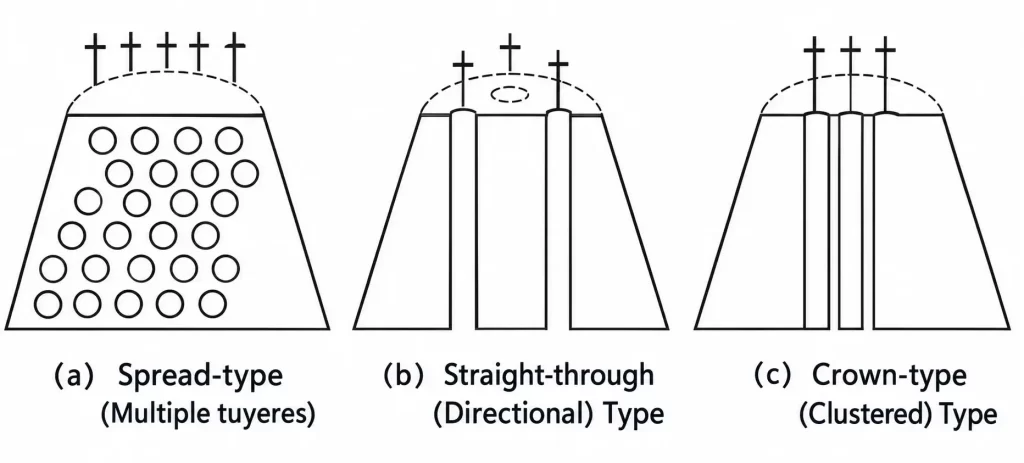
Diffusive gas-permeable brick
Diffusive-type gas-permeable bricks are characterized by high porosity and permeability. During production, carbon-containing compounds are added to the mixture; since these compounds burn off completely at low temperatures, the initial porosity is achieved through a low-temperature burnout process. The internal structure of these bricks features a network of interconnected pores of varying sizes. When gas flow is halted during operation, molten steel and slag from the ladle can penetrate deep into the brick through these pores, creating a dense, solidified zone at the working face. During ladle downtime or upon the resumption of gas flow, the working surface is subjected to periodic infiltration and erosive scouring by the molten steel, leading to issues such as pore clogging, flow blockage, or spalling.
A method for measuring the resistance coefficient of gas-permeable bricks was developed using existing testing equipment. By applying dimensional analysis and multiple linear regression, the measured results were found to align closely with experimental values, and the key parameters influencing the resistance coefficient were identified.
Straight-through directional porous plug
Gas-permeable bricks of the straight-through directional type feature gas channels designed as either straight-through holes or straight-through slits. Currently, the manufacturing of straight-through hole bricks for steel ladles is complex, and they suffer from low gas permeability; consequently, straight-through slit bricks have replaced the straight-through hole variety. In contrast, the straight-through hole structure remains the primary type used in converters. Research was conducted on various straight-through hole gas-permeable bricks and their high-density structural materials, evaluating properties such as thermal shock stability, resistance to iron oxide corrosion, and ambient-temperature strength; the results demonstrated that straight-through hole bricks maintain high bubbling reliability while also offering enhanced durability.
Slit-type directional gas-permeable brick
Currently, the slit-type structure is the most widely adopted design. By designing appropriate slits based on operational conditions—such as the steel grade, refining process, ladle capacity, temperature, and molten steel hydrostatic pressure—it is possible to optimize gas permeability, extend service life, and ensure stable safety performance.
Research was conducted on gas-permeable bricks made primarily from fused corundum and chromium oxide. By increasing the wetting angle between the material and the molten steel and reducing the slit width, the bricks’ gas permeability and erosion resistance were improved. Comparative studies showed that these bricks outperformed advanced international products in terms of permeability and service life, fully meeting the performance requirements for ladle refining operations.
The flow value of the castable was measured using the flow table method, alongside tests for bulk density, flexural strength at room temperature, and linear expansion rate after heat treatment at 1500°C. Results indicated that, compared to bricks with linear slits, those with annular slits exhibited enhanced gas permeability and extended service life, achieving a 100% gas-flow rate.
To improve upon traditional ladle powder injection technology, a slit-type gas-permeable brick featuring a conical fluidization chamber was developed for bottom-injection applications. During operation, a portion of the injected powder particles enters the brick’s slits along with the gas stream; however, another portion strikes the refractory walls, rapidly loses velocity, and falls back to accumulate within the slits, thereby obstructing gas flow. An investigation into the performance of ladle porous plugs during actual cyclic operation revealed a temperature difference between the working face (in contact with molten steel) and the permanent lining. This temperature gradient generates thermal stress, causing the width of the plug’s slit structure to increase; consequently, molten steel infiltrates the slits, reducing gas flow and eventually leading to complete blockage. By optimizing the positioning of the porous plugs—while keeping the number and length of the slits constant—it is possible to achieve rapid stirring of the molten steel during the smelting process, thereby significantly improving the uniformity of the steel’s composition and temperature.
Due to the specific requirements of steelmaking processes, diffuse-type and straight-through porous plugs are rarely used; instead, slit-type porous plugs have become widely adopted. By controlling the number and length of the slits, these plugs ensure effective gas flow and extend service life.
