
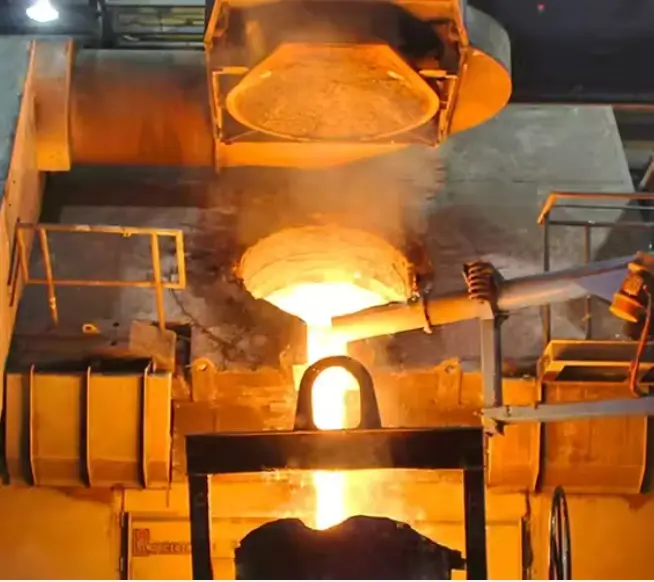
A medium-frequency furnace primarily consists of a power supply, an induction coil, and a crucible constructed of refractory material inside the induction coil. The crucible contains metal charge, which acts as the secondary winding of a transformer. When the induction coil is connected to an AC power source, an alternating magnetic field is generated within the coil. The magnetic flux lines cut through the metal charge in the crucible, inducing an electromotive force in the charge. Since the charge itself forms a closed circuit, this secondary winding is characterized by having only a single turn and being closed. Consequently, an induced current is simultaneously generated in the charge. As this induced current flows through the charge, it heats the material, causing it to melt.
A medium-frequency electric furnace uses a medium-frequency power source to establish a medium-frequency magnetic field, inducing eddy currents within ferromagnetic materials that generate heat, thereby achieving the purpose of heating the material. Medium-frequency electric furnaces use a 200–2,500 Hz medium-frequency power supply for induction heating, melting, and holding. They are primarily used for melting carbon steel, alloy steel, and special steels, and can also be used for melting and raising the temperature of non-ferrous metals such as copper and aluminum. The equipment is compact, lightweight, highly efficient, energy-efficient, and features rapid melting and heating rates. Furnace temperature is easy to control, and production efficiency is high.
I. What is the structure of a medium-frequency induction furnace lining and what is its function?
In a medium-frequency induction furnace, the material located between the induction coil and the metal being heated and melted is called the furnace lining (or crucible); it generally consists of a refractory layer, a thermal insulation layer, and an insulating layer.
The refractory layer is constructed by interlocking various refractory materials (acidic, basic, or neutral), which are then sintered at high temperatures before being put into service; the thermal insulation layer is located between the refractory layer and the induction coil, serving to insulate against heat, and consists of materials such as asbestos boards, asbestos cloth, and lightweight insulating bricks; the electrical insulation layer is made of high-temperature-resistant insulating materials (alkali-free or low-alkali glass cloth, natural mica tape, etc.) and is used to prevent electrical leakage from the induction coil.
The crucible is a vital component and key part of an induction melting furnace. In addition to holding molten metal and facilitating smelting, it also serves to provide thermal insulation, electrical insulation, and energy transfer. The material of the crucible must not only meet the required specifications and ensure a long service life but also possess certain electrical properties.
II. Classification of Refractory Materials
Crucibles used in induction furnaces can be classified into acidic, basic, and neutral crucibles based on the chemical properties of their refractory materials.
① Alkaline crucibles are made from alkaline refractory materials, typically sintered from magnesia (whose main component is magnesium oxide) or magnesium-aluminum spinel. When using magnesium-aluminum spinel material, the addition of boric acid lowers the spinel formation temperature and promotes spinel formation, thereby improving sintering quality and increasing the crucible’s compressive strength. ② Acidic crucibles are made from acidic refractory materials, primarily consisting of silica or natural ores with quartz sand as the main component. For crucibles made from quartz sand, the silicon dioxide (SiO₂) content must exceed 98%; the lower the content of harmful impurities in the quartz sand, the better. Quartz sand is inexpensive when used for furnace linings and is widely used in many small induction furnaces. ③ Neutral crucibles commonly use high-alumina aluminosilicate refractories, with an alumina (Al₂O₃) content greater than 46%; corundum refractories have an alumina content greater than 95%. They possess high chemical stability, volume stability at high temperatures, a very high softening point, and good slag resistance, with an operating temperature of up to 1,800°C; Crucibles made of graphite also fall under the category of neutral crucibles. (Here is a brief explanation of what magnesium-aluminum spinel is: it is a synthetic refractory material with a theoretical composition of 71.5% aluminum oxide and 28.5% magnesium oxide, a melting point of 2,135°C, a refractoriness of approximately 1,900°C, and good thermal shock resistance.)
The operating conditions for induction furnace crucibles are extremely harsh. Furthermore, the furnace lining is relatively thin, and the inner surface is directly exposed to thermal shock from high-temperature metal and erosion by molten slag. The agitation forces generated by the electromagnetic field subject the crucible to intense metal scouring. The outer surface of the crucible wall is in contact with water-cooled induction coils, resulting in a significant temperature difference between the interior and exterior. To extend the service life of the crucible, the refractory materials used in its construction must meet strict requirements: (1) Sufficiently high high-temperature resistance. The refractory materials used to construct the crucible must withstand temperatures exceeding 1,700°C, and their softening temperature must be greater than 1,650°C; (2) Good thermal stability. During operation, the temperature of the crucible walls fluctuates greatly, and the temperature distribution is uneven. Consequently, the walls undergo constant volumetric expansion and contraction, which can lead to cracking and directly affect the crucible’s service life; (3) Chemical stability: The crucible material should not undergo hydrolysis or pulverization at low temperatures, and at high temperatures, it should be resistant to decomposition and reduction, as well as erosion by slag and molten metal; (4) High mechanical strength. At room temperature, it must withstand the impact of furnace charge; at high temperatures, it must withstand the static pressure of molten metal and the intense agitation caused by electromagnetic induction, and the crucible walls must be resistant to scouring, wear, and erosion; (5) Low thermal conductivity to improve the furnace’s thermal efficiency; (6) Good electrical insulation. The crucible material must not conduct electricity at high temperatures; otherwise, it may cause electrical leakage and short circuits, leading to accidents. Before use, it is advisable to employ magnetic separation to remove conductive impurities mixed into the refractory material; (7) Good workability and ease of repair—that is, good sintering properties, making it easy to form and maintain; (8) Abundant resources and low cost.
For example, a 15-metric-ton medium-frequency furnace smelts steel grades such as 304, 301, and 204 stainless steel; therefore, the ramming mix consists of neutral and alkaline refractory materials, primarily including fused white corundum, fused magnesia, high-purity spinel, sintered magnesia, and medium- and low-temperature sintering agents. When ramming the medium-frequency furnace lining, asbestos cloth must be laid on the inner side of the inductor. Each layer of lining material on the furnace walls should be 100–140 mm thick, while the furnace bottom lining should be 300 mm thick. The lining thickness at the slag line should be 120 mm, and the wall thickness should be 90 mm. The furnace drying time must be ≥8 hours.
During operational observation, the lining of medium-frequency furnaces constructed using dry corundum-spinel rammed refractory material was found to have a smooth and even surface, with no cracks or spalling. Furthermore, a 4–6 mm layer of slag adhering to the surface formed, which helps reduce mechanical damage and slag erosion to the lining during the charging of scrap steel.
Alumina-spinel dry rammed refractory mixes sinter easily during the steelmaking process and possess high hot strength, meeting the requirements for stainless steel production. Furnace linings constructed with this rammed mix have a service life ranging from a minimum of 80 to a maximum of 108 batches, with an average erosion rate of 0.6 mm per batch—exceeding the service life of comparable foreign products. The formed lining of this medium-frequency furnace features excellent structural integrity and is easy to install and remove.
