
Classification of Refractory Materials for Electric Furnaces
- Refractory materials can be classified into 8 categories according to their chemical and mineral composition: Siliceous materials, Aluminosilicate materials, Magnesiac materials, Dolomite materials, Chromium materials, Carbonaceous materials, Zirconium materials, and Special Refractory materials.
- Refractory materials can be classified into 3 categories according to their chemical properties: Acidic refractories, Neutral refractories, and Basic refractories.
- Refractory materials can be classified into 3 categories according to their refractoriness: Ordinary refractories (1580-1770°C), High-grade refractories (1770-2000°C), and Extra-high-grade refractories (higher than 2000°C).
- Refractory materials can be classified into 7 categories according to their forming process: Natural rock forming, Press forming refractories, Cast forming refractories, Plastic forming refractories, Rammed forming refractories, Spray forming refractories, and Extruded forming refractories.
- Refractory materials can be classified into four categories according to heat treatment methods: fired bricks, unfired bricks, unshaped refractories, and molten (cast) products.
- Refractory materials can be classified into five categories according to shape and size: standard products, general-shaped products, irregular-shaped products, special-shaped products, and others, such as crucibles, dishes, and tubes.
- Refractory materials can be classified according to their application: refractories for the iron and steel industry, refractories for the non-ferrous metals industry, refractories for the petrochemical industry, refractories for the silicate industry (glass kilns, cement kilns, ceramic kilns, etc.), refractories for the power industry (power generation boilers), refractories for waste incineration melting furnaces, and refractories for other industries.
Physical and chemical properties of refractory materials
- Load softening point characterizes a material’s resistance to the combined effects of high temperature and heavy load, and also represents the softening temperature at which the material exhibits significant plastic deformation. This point refers to the temperature at which a sample deforms under a constant load under continuously increasing temperature conditions. Refractory bricks have high compressive strength at room temperature, but deform under pressure at high temperatures, significantly reducing their compressive strength. A static load of 2 kg is applied to each square centimeter of the refractory product, which is then heated gradually. The temperature at which the refractory product undergoes a certain degree of deformation is called the load softening point. Therefore, the load softening point is also an important indicator for evaluating the high-temperature structural strength of refractory products.
- Thermal shock resistance: The ability of a refractory material to not crack or peel under rapid temperature changes is called thermal shock resistance, also known as resistance to rapid heating and cooling, resistance to rapid temperature changes, resistance to thermal cracking, thermal shock resistance, or thermal shock stability. The thermal shock resistance of various refractory materials can be measured according to standard YB376. Clay-based refractories exhibit better thermal shock resistance, while magnesia bricks show slightly worse resistance. As furnace linings and materials used at high temperatures, refractories not only withstand high temperatures but also experience periodic temperature fluctuations during use. The ability of a refractory material to resist rapid temperature changes without damage is called its thermal shock resistance or thermal shock stability, which is a comprehensive reflection of its mechanical and thermal properties under varying temperature conditions. Drastic temperature changes can cause refractory products to crack, spall, or chip, leading to damage. Poor thermal shock resistance is a major cause of catastrophic damage to refractory linings under high-temperature conditions. Therefore, the thermal shock stability of a material has a significant impact on its service life.
- Oxidation resistance refers to the ability of carbon-containing refractories to resist oxidation in high-temperature oxidizing atmospheres. Carbon-containing refractories possess excellent slag resistance and thermal shock resistance, making them widely used in the metallurgical industry. However, carbon is easily oxidized; once oxidized, the properties of the product will be lost. Improving the oxidation resistance of carbon-containing products, especially their oxidation resistance under high-temperature conditions, is an important research topic for carbon-containing refractory materials.
Properties of commonly used refractory materials
Commonly used refractory materials: refractory bricks, high alumina bricks, castables, high alumina refractory bricks, insulating bricks, high alumina wear-resistant bricks, clay insulating bricks, and lightweight high alumina bricks.
- Acidic refractories, primarily composed of silicon dioxide, commonly include silica bricks and clay bricks. Silica bricks are siliceous products containing over 93% silicon dioxide, using raw materials such as silica and waste silica bricks. They exhibit strong resistance to acidic slag erosion, high softening temperature under load, and do not shrink in volume after repeated firing, even expanding slightly. However, they are susceptible to erosion by alkaline slags and have poor thermal shock resistance. Silica bricks are mainly used in thermal equipment such as coke ovens, glass melting furnaces, and acidic steelmaking furnaces. Clay bricks, primarily made from refractory clay, contain 30%–46% alumina. They are weakly acidic refractories with good thermal shock resistance and resistance to acidic slag corrosion, and are widely used.
- Neutral refractories, primarily composed of alumina, chromium oxide, or carbon. Corundum products containing over 95% alumina are a widely used, high-quality refractory material. Chromium bricks, with chromium oxide as the main component, exhibit good corrosion resistance to steel slag but poor thermal shock resistance and a low high-temperature load deformation temperature. Carbonaceous refractories, including carbon bricks, graphite products, and silicon carbide products, have very low coefficients of thermal expansion, high thermal conductivity, good thermal shock resistance, high high-temperature strength, resistance to acid, alkali, and salt corrosion, are not wetted by metals or molten slag, and are lightweight. They are widely used as high-temperature furnace lining materials and also as linings for high-pressure reactors in the petroleum and chemical industries.
- Alkaline refractories, with magnesia and calcium oxide as the main components, commonly use magnesia bricks. Magnesia bricks containing 80%–85% or more magnesia have excellent resistance to alkaline slag and iron slag, and their refractoriness is higher than that of clay bricks and silica bricks. They are mainly used in open-hearth furnaces, oxygen-blown converters, electric furnaces, non-ferrous metal smelting equipment, and some high-temperature equipment.
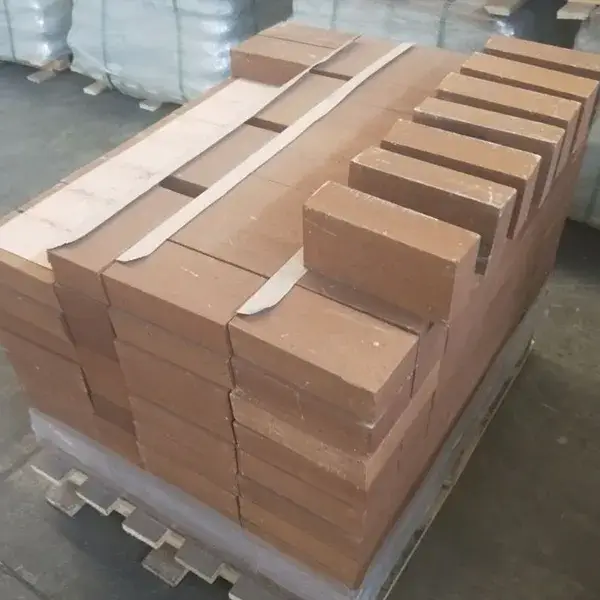
Commonly used refractory materials and their application methods
- Hydration Bonding – Bonding occurs through a hydration reaction between the binder and water at room temperature, producing hydration products.
- Chemical Bonding – Bonding occurs through a chemical reaction between the binder and a hardener, or between the binder and the refractory material, at room temperature, or upon heating, producing compounds that act as binders.
- Polymerization Bonding – Bonding strength is achieved by adding catalysts or crosslinking agents, causing the binder to undergo condensation polymerization to form a network structure.
- Ceramic Bonding – This refers to low-temperature sintering bonding, achieved by adding additives or metal powders to loose refractory materials to lower the sintering temperature, significantly reducing the liquidus appearance temperature and promoting a low-temperature solid-liquid reaction.
- Adhesive Bonding – Bonding occurs through one of the following physical processes. Physical adsorption: Bonding occurs through intermolecular forces—van der Waals forces. Diffusion: Under the influence of thermal motion, the molecules of the binder and the adherend diffuse, forming a diffusion layer and thus a strong bond. Electrostatic attraction: A double electric layer exists at the interface between the binder and the adherend; bonding occurs through the electrostatic attraction of this double layer. Cohesive bonding: Bonding occurs by adding a cohesive agent to cause the aggregation of microparticles (colloidal particles).
