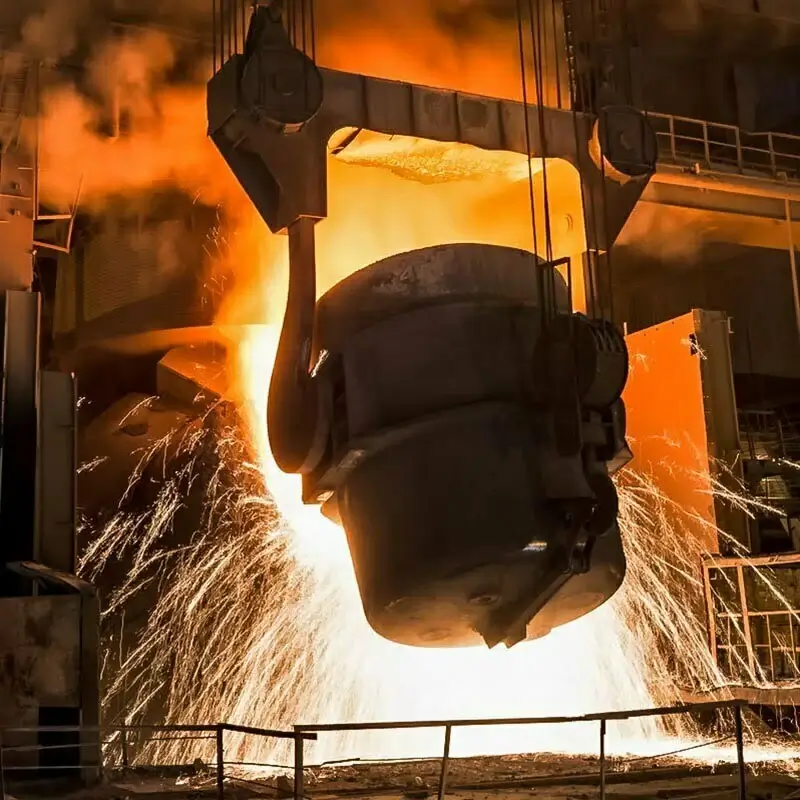
Steel ladles serve the dual purpose of carrying molten steel and refining it outside the ladle. With the development of steelmaking technology, refractory materials for steel ladles in my country have also seen significant progress. Especially since the 1980s, Chinese refractory research institutions, manufacturers, and users have worked closely together, combining their expertise with my country’s specific conditions, to continuously develop new types of refractory materials for steel ladles. This has enabled the rapid development of refractory materials for steel ladles in my country, meeting the needs of the rapidly developing steelmaking industry.
1.Refractory materials for steel ladles
From the 1950s to the 1970s, aluminosilicate refractories, including various clay bricks and high-alumina bricks, were mainly used for steel ladle linings in my country. Since the 1980s, my country has successively developed several series of new steel ladle refractories, including alumina-magnesia (carbon), magnesia-carbon, and magnesia-calcium (carbon). Among them, alumina-magnesia (carbon) refractories are the most diverse and come in the most complete specifications, making them the main type of steel ladle refractories used in my country.
1.1 Aluminosilicate steel ladle refractory material
1.1.1 Clay bricks
Clay bricks were the earliest refractory materials used for steel ladles in my country. In the 1950s and 60s, various types of clay bricks were the main refractory materials used in Chinese steel ladles. Due to their low cost, some steel plants continued to use clay bricks in their ladles until the 1980s. The physicochemical properties of clay bricks used in steel ladles at a certain steel plant are: Al₂O₃ 44.10%, SiO₂ 52.10%, Fe₂O₃ 1.72%, apparent porosity 16%–18%, and room temperature compressive strength 54.9–96.0 MPa. The service life of clay ladle lining bricks varies depending on the operating conditions of each steel plant.
Although clay bricks are no longer used in my country’s steel ladles, they made a significant contribution to the recovery and subsequent development of my country’s steelmaking industry in the early days of the People’s Republic.
1.1.2 High-alumina bricks
With the continuous development of steelmaking technology and the continuous improvement of steel output and quality, clay-based steel ladle lining bricks, due to their short service life, led some steel plants in my country to begin using various high-alumina lining bricks in their ladles from the late 1960s onwards, significantly extending the ladle’s lifespan.
The 270t ladles used in the open-hearth furnaces of Wuhan Iron and Steel (WISCO) began using second-grade high-alumina bricks in 1968, reaching a service life of 25.7 cycles by 1970, 2.5 times that of clay-based lining bricks. In 1974, the service life reached 31.5 cycles. The 70t ladles used in the converters of WISCO’s No. 2 steelmaking plant began using high-alumina bricks with an Al2O3 content greater than 72% in 1980, achieving a service life of 34 cycles, with a maximum of 50 cycles.
The 300t ladles of Baosteel, starting in June 1986, used first-grade high-alumina bricks produced by a certain refractory materials plant for the entire ladle wall, with an average service life of around 50 cycles. After the continuous casting machine was put into operation, the operating conditions of the ladles deteriorated, shortening the service life of the lining. Baosteel collaborated with certain refractory material manufacturers to develop high-alumina micro-expansion bricks with excellent performance. In April 1992, they officially began using products manufactured by Plant A, achieving an average service life of 81.5 cycles and a maximum service life of 100 cycles. Using products from Plant B, the average service life was 78.6 cycles, with a maximum of 122 cycles (continuous casting ratio 55.73%).
The 70t steel ladle of Taiyuan Iron & Steel Group (TISCO) uses high-alumina lining bricks, with a service life of 64.3 cycles. In summary, the use of high-alumina lining bricks in steel ladles in my country has significantly improved the service life of steel ladles, ensuring the smooth operation of steelmaking and promoting the further development of the steelmaking industry.
1.1.3 High-alumina ramming mix
In the late 1970s, some steel plants in my country used high-alumina ramming mix for the lining of their ladles, achieving good results. High-alumina ramming mix is a highly malleable monolithic refractory material made from high-quality high-alumina bauxite clinker (aggregate and fine powder) and industrial phosphoric acid as a binder, through batching and mixing. Using integral ramming technology, monolithic linings were created, resulting in a longer service life.
1.1.4 Wax Stone Bricks
Wax stone bricks are fired products made primarily from pyrophyllite. In the early 1970s, wax stone ladle bricks produced by a refractory materials plant in Fujian Province were tested on different types of ladles in steel companies such as Maanshan Iron and Steel, Anshan Iron and Steel, Shanghai No. 3 Steel Plant, and Sanming Steel Plant. The results showed that the performance of wax stone bricks was superior to that of clay bricks and grade III high-alumina bricks used at the time. On a 15t ladle at Maanshan Iron and Steel, the bricks achieved a service life of 66 cycles. A 70t ladle at Wuhan Iron and Steel’s No. 2 Steelmaking Plant also tested wax stone bricks with a SiO2 content of 72% produced by the plant, but the results were less than ideal, with a service life of only 14 cycles. Baosteel’s 300t ladle used imported wax stone bricks from Japan between September 1985 and 1988, with an average service life of 38 cycles. The physicochemical properties of wax stone bricks for steel ladles produced by a certain factory are as follows: SiO2 78.95%, Al2O3 18.85%–19.51%, Fe2O3 0.44%–0.52%, apparent porosity 14%–18%, and room temperature compressive strength 32.9–62.9 MPa. Due to various reasons, wax stone bricks have not been widely adopted in steel ladles in my country.
2.2 Refractory materials for aluminum-magnesium (carbon) steel ladles
Since the 1980s, my country’s steelmaking industry has entered a phase of rapid development. The widespread application of modern steelmaking technologies such as continuous casting and ladle refining, along with the increase in clean steel production, has made the operating conditions of ladle refractories more demanding. Increased steel temperatures, longer residence times of molten steel in the ladle, and more severe erosion of the refractories by molten steel and slag, as well as chemical corrosion by slag, have rendered traditional ladle refractories inadequate for modern steelmaking needs. Therefore, my country has successively developed various alumina-magnesia (carbon) refractories for ladles. During use, Al₂O₃ and MgO react at high temperatures to form magnesium aluminum spinel, a mineral with excellent high-temperature properties, significantly improving the erosion resistance and spalling resistance of the refractories. Thus, the use of alumina-magnesia (carbon) refractories for ladles can substantially extend the service life of the ladle.
2.2.1 Monolithic Aluminum-Magnesium Ramming Mixture
In the early 1980s, the Luoyang Refractories Institute, Anshan Coking and Refractory Institute, and Anshan Iron and Steel Group collaborated to develop an alumina-magnesium alloy monolithic ramming mix for steel ladles. This ramming mix is a highly malleable monolithic refractory material formulated with high-grade high-alumina bauxite clinker as aggregate, a mixture of high-grade high-alumina bauxite clinker powder and sintered magnesia powder as matrix, and liquid water glass as a binder. When used on 200t steel ladles at Anshan Iron and Steel Group’s No. 3 Steelmaking Plant, its service life was 5-7 times longer than that of clay bricks, with an average service life of 85.15 cycles and a maximum of 108 cycles, and a refractory material consumption of 2.7 kg per ton of steel. In June 1982, this ramming mix passed the appraisal of the former Ministry of Metallurgical Industry. Subsequently, many steel plants across the country adopted this alumina-magnesium alloy monolithic ramming mix for steel ladles, achieving excellent results.
2.2.2 Aluminum-magnesium castable
Following the development of alumina-magnesia ramming mixes, my country developed alumina-magnesia castable refractory made from high-quality high-alumina bauxite clinker and sintered magnesia, using liquid water glass as a binder. During the Sixth Five-Year Plan period, this castable refractory was first applied to small steel ladles, achieving excellent results. For example, a steel plant in Hebei province used water glass-bonded alumina-magnesia castable refractory for 10t and 14t ladles, achieving an average lifespan of 109.7 cycles, more than eight times that of clay brick linings. A steel plant in Heilongjiang province used alumina-magnesia castable refractory for 15t and 13t ladles, achieving a lifespan of 53 cycles, while clay brick linings only lasted 6-10 cycles. During the Seventh Five-Year Plan period, the integral castable lining technology for steel ladles was listed as a key new technology promotion project of the former Ministry of Metallurgical Industry and promoted nationwide. By the third quarter of 1987, most medium and small steel ladles (capacity below 45t) used in converters under 30t in my country adopted integral castable lining. The service life of integral castable linings is mostly 40-60 cycles, and some small ladles can reach 90 cycles. Refractory material consumption and lining costs have been significantly reduced, resulting in substantial economic benefits. The physicochemical properties of water glass-bonded aluminum-magnesium castables used in a steel plant’s ladles are: Al2O3 75.20%, MgO 9.47%, SiO2 10.25%, bulk density (110℃×24h) 2.67-2.73 g./cm3, and room temperature flexural strength (110℃×24h) 14.9 MPa.
2.2.3 Aluminum-magnesium non-fired bricks
Besides aluminum-magnesium ramming mixes and aluminum-magnesium castables, my country has also developed water glass-bonded aluminum-magnesium unfired bricks for use in steel ladles, which have a longer service life than traditional aluminosilicate ladle bricks. Benxi Steel’s 160t ladle uses aluminum-magnesium unfired bricks, with an average service life of 40.56 cycles, more than double that of using grade III high-alumina bricks (18.5 cycles). Tianjin No. 3 Steel Plant’s 20t ladle uses aluminum-magnesium unfired bricks with an average service life of 38.8 cycles, reaching a maximum of 55 cycles, more than four times the service life of clay lining bricks (9 cycles). The physicochemical properties of water glass-bonded aluminum-magnesium unfired bricks produced by a certain factory are as follows: Al2O3 68.46%~74.07%, MgO 7.65%~12.32%, SiO2 9.02%~13.37%, Fe2O3 1.12%~1.83%, bulk density 2.48~2.86g/cm3, apparent porosity 16%~23%, and room temperature compressive strength 55.6~123MPa.
2.2.4 Magnesium Aluminum Spinel Castable
In the early 1990s, with the industrial production of bauxite-based synthetic magnesia-alumina spinel as a refractory raw material in my country, several refractory material research institutions and manufacturing enterprises in my country successively developed various bauxite-based magnesia-alumina spinel castables for steel ladles with different performance characteristics. Because these castables incorporate a certain proportion of pre-synthetic magnesia-alumina spinel, their erosion resistance and spalling resistance are greatly improved, and their performance is superior to that of water glass-bonded alumina-magnesia castables. They have achieved good results in various steel ladles. The bauxite-based alumina-magnesia spinel castable jointly developed by Luoyang Refractory Research Institute and a refractory material plant in Henan Province was tested on a 70t (DH vacuum lance argon blowing) steel ladle of Taiyuan Iron & Steel Group and a 30t continuous casting steel ladle of Hefei Iron & Steel Group (continuous casting ratio not less than 94%). The average service life reached 71 cycles and 114 cycles respectively, which is 1 to 3 times higher than that of water glass-bonded alumina-magnesia castables. A steel plant in Hangzhou uses magnesium-aluminum spinel castable in its 25t continuous casting ladles (continuous casting ratio greater than 70%), achieving an average lifespan of 77 cycles, 1.2 times longer than water glass-bonded aluminum-magnesium castable. A steelmaking plant in Jiangxi’s Xinyu Steel Group uses magnesium-aluminum spinel castable in its 28t ladles, achieving an average lifespan of 79 cycles, 1.6 times longer than water glass-bonded aluminum-magnesium castable.
Bauxite-based magnesium-aluminate spinel castable uses high-quality high-alumina bauxite clinker as aggregate, and high-quality high-alumina bauxite clinker powder, synthetic magnesium-aluminate spinel powder, and sintered magnesia powder as matrix. The binders include polyphosphate, SiO2 micro powder, Al2O3 micro powder, and pure calcium aluminate cement. The physicochemical properties of a certain factory’s bauxite-based magnesium-aluminate spinel castable are: Al2O3 68.84%, MgO 14.63%, SiO2 11.27%, Fe2O3 1.74%, bulk density (110℃×24h) 2.73 g/cm3, room temperature compressive strength 42.88 MPa, and room temperature flexural strength 55.1 MPa.
2.2.5 Alumina-magnesia-carbon bricks
In the 1990s, my country’s continuous casting technology developed rapidly, and high-efficiency continuous casting technology became the focus of its development. In order to improve the service life of continuous casting ladles and meet the needs of the development of high-efficiency continuous casting technology, my country developed aluminum-magnesium-carbon bricks for ladles, which were used in various types of continuous casting ladles, greatly improving the service life of ladles. The aluminum-magnesium-carbon ladle bricks developed by Luoyang Refractories Research Institute, Baosteel and a certain refractory material plant in Jiaozuo were used on Baosteel’s 300t continuous casting ladle. The ladle life increased from more than 20 times when using first-class high-alumina bricks to more than 80 times, with a maximum of 126 times [16]. The 200t fully continuous casting and ladle refining ladle of Anshan Iron and Steel Group No. 3 Steelmaking Plant used aluminum-magnesium-carbon bricks, with an average service life of 64 times and a maximum of 73 times. In 1993, the widespread application of high-quality alumina-magnesia-carbon bricks for steel ladles was launched across my country. Many steel plants nationwide adopted these bricks based on their specific circumstances, significantly extending the lifespan of their ladles. For example, at Panzhihua Iron and Steel Group, the average lifespan of their 160-ton ladles increased to 90 cycles, with a maximum of 115 cycles. Alumina-magnesia-carbon bricks are non-fired products made from high-grade high-alumina bauxite clinker, fused or sintered magnesia, and graphite, using liquid phenolic resin as a binder.
2.2.6 Magnesium Aluminum Spinel Carbon Bricks
Building upon the development of alumina-magnesia-carbon bricks, my country has further developed magnesia-alumina spinel-carbon bricks for steel ladles. These bricks incorporate a certain proportion of pre-synthesized magnesia-alumina spinel into the brick material, resulting in superior performance compared to comparable alumina-magnesia-carbon bricks. Magnesia-alumina spinel-carbon bricks developed by a refractory materials plant in Jiaozuo in cooperation with Baosteel have been used in Baosteel’s 300t continuous casting ladles, achieving an average service life of 105 cycles, with a maximum of 200 cycles. Magnesia-alumina spinel-carbon bricks developed by the China Academy of Building Research have been used in Ansteel’s 200t continuous casting ladles undergoing ladle refining, achieving an average service life of 73.3 cycles, with a maximum of 82 cycles. Magnesia-alumina spinel-carbon bricks developed by Shougang in cooperation with a refractory materials plant in Xinxiang have been used in Shougang’s No. 2 steelmaking plant’s 90t ladles, increasing the service life from 20 cycles compared to the previous alumina-magnesia-carbon bricks to 40 cycles, with a maximum of 51 cycles. The development and use of aluminum-magnesium spinel carbon bricks have further improved the service life of continuous casting ladles in my country.
2.2.7 High-grade aluminum-magnesium non-fired bricks
Carbon steel ladle lining bricks cause carbon increase in molten steel during use, which is highly detrimental to the smelting of clean steel, low-carbon steel, and ultra-low-carbon steel. To meet the needs of smelting clean steel, low-carbon steel, and ultra-low-carbon steel, high-grade alumina-magnesium unfired bricks (carbon-free unfired bricks) have been developed. Compared to the water glass-bonded alumina-magnesium unfired bricks developed in the early 1980s, high-grade alumina-magnesium unfired bricks represent a qualitative leap. In addition to using high-purity raw materials (corundum, high-purity fused magnesia, and high-purity alumina-magnesium spinel, etc.), high-performance composite binders are also used.
High-grade alumina-magnesia unburned bricks have achieved excellent results in steel ladles, with a service life reaching or even exceeding that of carbon steel ladle lining bricks, while reducing carbon gain in molten steel. For example, alumina-magnesia unburned bricks developed by a refractory materials company in Henan Province, used in a steel plant’s 100t steel ladle and LF refining steel ladle, have a service life 1.5 times that of alumina-magnesia-carbon bricks.
Ansteel’s 200t steel ladle using alumina-magnesia unburned bricks has achieved a service life of over 110 cycles, with a maximum of 128 cycles. The service life of its 170t continuous casting steel ladle reached 119 cycles, exceeding that of alumina-magnesia-carbon bricks. Baosteel’s 300t continuous casting steel ladle stopped using alumina-magnesia-carbon bricks in June 1998 and began using high-grade alumina-magnesia unburned bricks.
2.2.8 High-grade alumina-magnesia (spinel) castables
In the mid-1990s, my country developed high-grade alumina-magnesia castables for use in large and medium-sized steel ladles. The raw materials used in high-grade alumina-magnesium (spinel) castables include corundum (fused alumina, sintered alumina, etc.), high-purity fused magnesia, and high-purity alumina-magnesium spinel (fused and sintered). The binders include pure calcium aluminate cement, Al2O3 micro powder, and high-purity SiO2 micro powder. Baosteel’s 300t steel ladle began trial use of high-grade alumina-magnesium castables developed by several refractory material plants in my country in December 1996, achieving an average service life of 258 cycles by 2000. The high-grade alumina-magnesium spinel castable developed by Shougang’s No. 3 Steelmaking Plant in collaboration with a refractory company in Xinxiang was used on Shougang’s No. 3 Steelmaking Plant’s 90t LF refining steel ladle, achieving a service life of 138 cycles and an erosion rate of 0.62 mm/cycle. Ansteel’s No. 3 Steelmaking Plant used high-grade alumina-magnesium (spinel) castables in its 200t continuous casting steel ladle, achieving a service life of 150 cycles. Other steel plants have also used precast castable blocks with good results. For example, the service life of Benxi Steel’s ladles using aluminum-magnesium-carbon bricks was 65 cycles. After switching to high-grade aluminum-magnesium spinel precast blocks, the average service life increased to 118 cycles, with a maximum of 126 cycles. By 2000, 90% of Benxi Steel’s ladles were lined with high-grade aluminum-magnesium castable precast blocks.
2.3 Refractory materials for magnesia-carbon steel ladles
2.3.1 Magnesia-carbon bricks
Magnesia-carbon bricks possess excellent erosion resistance and spalling resistance. In steel ladles, magnesia-carbon bricks are primarily used in the slag line section, while other refractory materials (castables, unfired bricks, etc.) are used in non-slag line sections. This approach achieves a longer service life while reducing refractory material costs. The physicochemical properties of magnesia-carbon bricks used in the slag line of a certain steel plant are: MgO 77.4%, C 16.75%, apparent porosity 3.1%, bulk density 2.90 g/cm³, and room temperature compressive strength 38.6 MPa. In September 1981, Wuhan Iron and Steel’s No. 2 Steelmaking Plant pioneered the use of magnesia-carbon bricks in its 70t ladle slag line, achieving a service life of 50 cycles. However, their use was discontinued due to severe damage to high-alumina bricks in non-slag line sections. Baosteel’s 300t ladle slag line began using MT-14A magnesia-carbon bricks in July 1989, maintaining a slag line service life exceeding 100 cycles. A steel plant uses magnesia-carbon bricks with a carbon content of approximately 16% in its 90t LF refining ladle slag line, achieving a slag line life of 95 cycles. Some steel plants use full magnesia-carbon brick linings for their ladles; for example, a steel plant’s electric arc furnace uses a 60t LF-VD refining ladle lined entirely with magnesia-carbon bricks, achieving an average lifespan of 47 cycles and a maximum of 57 cycles.
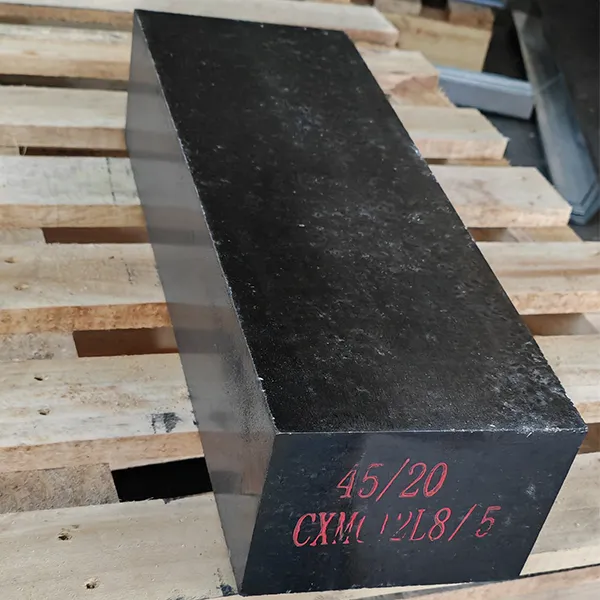
2.3.2 Low-Carbon Magnesia-Carbon Bricks
Using magnesia-carbon bricks in ladle slag lines presents the problem of increased carbon content in molten steel. In recent years, some steel plants have collaborated with refractory material manufacturers to develop low-carbon magnesia-carbon bricks for ladle slag lines. Baosteel’s 300t ladle slag line has tested low-carbon magnesia-carbon bricks with carbon contents of less than 7% and less than 5%, achieving a lifespan of approximately 110 cycles, comparable to ordinary magnesia-carbon bricks, which basically meets the requirements for 300t ladles. Ansteel’s ladle slag line also uses low-carbon lining bricks with a carbon content below 5%, with good results.
2.4 Refractory materials for magnesium-calcium (carbon) steel ladles
Magnesia-calcium refractories possess excellent high-temperature stability and resistance to high-alkalinity slags. In particular, the free CaO within them helps purify molten steel, making them one of the ideal refractories for steel ladles. With the continuous increase in the production of clean steel, the application of magnesia-calcium refractories will continue to expand.
2.4.1 Dolomite ramming mix
In the early 1980s, Taiyuan Iron & Steel Group (TISCO) used ordinary sintered dolomite as raw material and medium-temperature pitch as binder to make dolomite ramming mix, which achieved good results when used on 70t steel ladles, with an average service life of 76 cycles and a maximum of 112 cycles.
2.4.2 Unfired magnesia-calcium bricks
In the early 1990s, the Luoyang Refractory Institute developed unburned magnesia-calcium sand bricks for steel ladles using synthetic magnesia-calcium sand and fused magnesia as raw materials, and solid inorganic salts and inorganic salt solutions as binders. These bricks were used in a 40t LF-VD refining ladle at a steel plant in Shanghai, achieving a service life of over 40 cycles, and reducing the oxygen content in the steel from 12.2 × 10⁻⁶ to 11.13 × 10⁻⁶. In 1992, the product passed the appraisal of the former Ministry of Metallurgical Industry and was subsequently used in refining ladles at steel plants such as Great Wall Special Steel Plant. In recent years, a refractory materials company has developed anhydrous resin-bonded unburned magnesia-calcium sand bricks, which have been used in a 100t LF refining ladle at a steel company, achieving a service life of 80-85 cycles and an erosion rate of 1.28-1.37 mm/cycle. Between July and August 2006, Shandong Magnesium Mine collaborated with a refractory materials plant to develop non-fired magnesia-calcium bricks. These bricks were used in the non-slag line section of the 90tLF refining ladle (100% refining rate) at a steel plant, achieving a service life of over 60 cycles. Due to severe corrosion of the bottom permeable bricks, their use was discontinued. The remaining thickness of the non-fired magnesia-calcium bricks was approximately 130mm, indicating continued usability. A normal ladle life of 80-100 cycles was projected.
2.4.3 Unfired magnesia-calcium-carbon bricks
At the beginning of this century, Shougang No. 2 Steelmaking Plant collaborated with a refractory materials company to develop non-fired magnesia-calcium carbon bricks using synthetic magnesia-calcium sand, fused magnesia, and high-purity graphite as raw materials and anhydrous resin as a binder. These bricks were used in the non-slag line section of the 225t steel ladle at Shougang No. 2 Steelmaking Plant (magnesia-carbon bricks for slag line), achieving an average service life of 116.8 cycles. Compared to the original alumina-magnesia-carbon bricks, this represented an increase of 37.57 cycles despite a 20mm reduction in ladle wall thickness. Furthermore, the oxygen content and non-metallic inclusions in the steel were reduced. Several other steel mills in my country have also used magnesia-calcium carbon bricks in the slag line sections of various refining ladles, including those from SKF and LF-VD, with good results.
2.5 Zircon bricks
Between September 1985 and 1989, Baosteel’s 300t steel ladles used imported Japanese zirconium ladle lining bricks, with an average service life of 90 cycles. During this period, a refractory materials plant in Wuxi also developed its own zirconium ladle lining bricks using domestically produced raw materials. These were tested on Baosteel’s 300t steel ladles, achieving a service life of 88 cycles before being discontinued due to a malfunction in the bottom sliding plate mechanism. The physicochemical properties of the domestically produced zirconium ladle lining bricks are: ZrO2 60.80%, Al2O3 1.76%, Fe2O3 0.60%, bulk density 3.53 g/cm3, apparent porosity 19%, and room temperature compressive strength 62.9 MPa.
In summary, since the 1950s, with the continuous development of steelmaking technology in my country, the refractory materials for steel ladles have also been constantly developing, with new product varieties increasing, product quality continuously improving, and performance becoming increasingly better, meeting the needs of the ever-growing steelmaking industry in my country. Based on the development trend of my country’s steelmaking industry, it is recommended that future development of refractory materials for steel ladles should focus on the following aspects:
(1) Develop refractory materials for steel ladles with longer service life to meet the needs of efficient continuous casting and ladle refining.
(2) Develop low-carbon, carbon-free, and magnesium-calcium series refractory materials for steel ladles with better corrosion resistance and spalling resistance to meet the needs of smelting clean steel, low-carbon steel, and ultra-low-carbon steel.
(3) Develop energy-saving refractory materials for steel ladles, such as unshaped refractories and unfired bricks.
(4) Develop resource-saving and environmentally friendly refractory materials for steel ladles.
(5) Conduct research on the reuse of various post-use residual refractory materials for steel ladles.