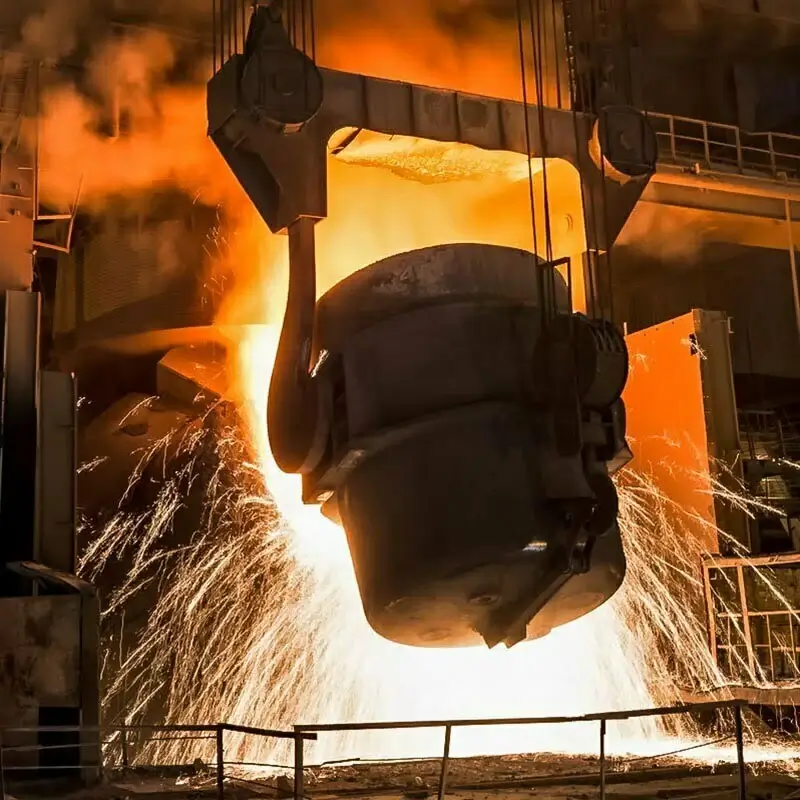
In the core applications of high-temperature industries, there is a material that quietly withstands the scorching heat of thousands of degrees, safeguarding the safety and stability of production processes—refractory materials. As an indispensable backbone for sectors such as steel, building materials, non-ferrous metallurgy, and new energy, the level of development in refractory materials not only directly determines the quality of downstream industrial upgrades but is also closely linked to the advancement of the “dual carbon” goals and the optimization of industrial structures. Today, the refractory materials industry is moving beyond the constraints of extensive development and steadily advancing toward high-end, green, and intelligent solutions. Through capacity optimization, technological breakthroughs, and evolving market demands, it is writing a new chapter of innovation in the field of high-temperature materials.
Industry Fundamentals: Definitions, Classification, and Core Value
Refractory materials refer to a class of inorganic non-metallic materials that can maintain structural strength, resist chemical erosion and thermal shock in high-temperature environments, and have a refractoriness of at least 1,580°C. Their core value lies in creating a “protective barrier” for high-temperature production processes, thereby reducing heat loss, extending equipment lifespan, and ensuring production safety. Based on different classification criteria, refractory materials form a well-defined product system suitable for diverse application scenarios.
Based on chemical composition, they can be divided into three major categories: acidic, basic, and neutral refractories. Acidic refractories, primarily silica- and zirconia-based, are suited for acidic operating conditions in industries such as glass and ceramics; Alkaline refractories, centered on magnesia and magnesia-alumina, serve as essential consumables in alkaline environments such as steel smelting. Notably, Liaoning Province accounts for 75% of the nation’s total production of alkaline refractories, demonstrating a significant regional advantage; neutral refractories, represented by high-alumina and corundum types, possess both acid- and alkali-resistant properties and are widely used in critical areas of high-temperature furnace structures.
By form, refractories can be classified into shaped and unshaped types: Shaped refractories, or refractory bricks, serve as the core material for furnace lining construction due to their uniform shape and stable performance; unshaped refractories (such as castables and plastic refractories) do not require molding or sintering and can be directly applied or poured, making them suitable for equipment with complex structures. In recent years, as construction techniques have advanced, their share of applications has continued to rise.
As the “cornerstone” of high-temperature industries, refractory materials are far more critical than ordinary consumables: in the steel industry, they underpin the entire production process, including blast furnaces, converters, and continuous casting; in the new energy sector, they ensure the stable operation of lithium battery sintering furnaces and hydrogen electrolysis cells; and in the building materials industry, they safeguard the long-term service life of cement kilns and glass furnaces, with their performance directly impacting downstream product quality, production efficiency, and safety standards.
Industry Overview: Steady Progress with Significant Structural Improvements
Currently, against the backdrop of production capacity optimization, industry consolidation, and diversifying demand, the refractory materials industry is demonstrating a development trend characterized by “steady progress and improved quality and efficiency.” The overall operational quality of the industry has significantly improved compared to previous years, yet it still faces certain structural challenges that urgently need to be addressed.
(1) Production Capacity Landscape: Increased Concentration and Accelerated Exit of Inefficient Capacity
With the continued implementation of industry policies aimed at optimizing production capacity and the ongoing refinement of mechanisms for phasing out inefficient capacity, the refractory materials industry has seen steady yet adjusted capacity levels and a more rational structure. The total production capacity of refractory products nationwide stands at approximately 21.5 million tons, with actual output reaching 20.8 million tons. The capacity utilization rate has risen to 96.7%, completely overcoming the previous challenges of overcapacity and resource waste. Industry concentration continues to rise, with leading enterprises demonstrating a clear competitive edge. The market share of the top 10 companies (CR10) has increased to 22%, and the total output of major production regions accounts for 80% of the national total, resulting in a more rational regional distribution.
(2) Technological Innovation: Breakthroughs in High-End Products and Deep Integration of Green and Smart Technologies
In recent years, the refractory materials industry has increased investment in scientific and technological innovation, focused on tackling core technological challenges, and promoted the transformation of technology toward high-end, green, and smart applications. New products have continuously emerged, and the level of technical equipment has significantly improved. Research and development of high-end products has accelerated, with application scenarios continuously expanding. Nanomodification technology is widely applied, synergistically enhancing the erosion resistance and thermal shock resistance of low-carbon refractory materials. Green technologies have been comprehensively promoted; measures such as replacing sintering processes with electrically fused magnesia and recycling waste refractory materials have effectively reduced energy consumption and emissions. Intelligent technologies have been deeply integrated, with “5G+Smart Factories” and intelligent furnace-building robots achieving large-scale application, significantly improving production efficiency and product quality.
(3) Market Demand: Diversification in Downstream Sectors, with Emerging Fields Becoming New Engines
The market demand for refractory materials exhibits a pattern of “consolidating the foundation in traditional sectors while experiencing explosive growth in emerging sectors.” As the largest consumer sector, the steel industry accounts for 64% of refractory demand. With the advancement of the steel industry’s green and low-carbon transformation, the comprehensive refractory consumption per ton of steel has continued to decline; consumption in the cement industry has remained stable, and the industry target for refractory consumption per ton of cement clinker has been achieved ahead of schedule. Meanwhile, demand for refractories in emerging sectors such as new energy and semiconductors continues to rise, becoming a new driver of demand. The export market has also expanded steadily, covering 150 countries and regions worldwide.
Technological Frontiers: Multidimensional Innovation Leading the Way in Industry Upgrades
Currently, technological innovation in the refractory materials industry is characterized by “interdisciplinary convergence and system integration.” Cutting-edge technologies such as smart response, nano-modification, and ultra-high-temperature composites are moving from the laboratory to industrial-scale production, driving a qualitative leap forward in the industry. Smart-responsive refractory materials have made the leap from “passive endurance” to “active adaptation,” enabling real-time visualization of operational status and precise prediction of service life. Innovations in ultra-high-temperature composite material systems continue to meet the demands of extreme operating conditions. Breakthroughs in green and low-carbon technologies are ongoing, with the high-value utilization of solid waste emerging as a new direction, injecting fresh momentum into the industry’s low-carbon development.
Outlook for the Future: Focusing on High-End Green Initiatives to Build an Ecosystem for High-Quality Development
The refractory materials industry is poised to embrace a new round of development opportunities. Moving forward, the industry will continue to promote industrial consolidation, deepen technological innovation and product upgrades, accelerate the transition toward green, low-carbon, and smart manufacturing, and enhance the collaborative ecosystem across the industrial chain. These efforts will drive higher-quality development in the refractory materials sector and contribute China’s strength to the green transition and efficiency improvements in global high-temperature industries.