
Functional refractory components—specifically monolithic stopper rods, long nozzles (ladle-to-tundish shrouds), submerged entry nozzles (tundish-to-mold nozzles), and tundish nozzles—are collectively known as the “three major continuous casting components.” They are primarily made from alumina-carbon, alumina-zirconia-carbon, magnesia-carbon, or magnesia-alumina spinel-carbon materials and are manufactured using isostatic pressing. Molding pressures typically range from 50 MPa to 125 MPa, with specific pressures selected based on the nozzle’s location and the particle size distribution of the material. The reasons for this are as follows:
(1) The length-to-diameter ratios required for these monolithic stopper rods, long nozzles, and submerged entry nozzles are very high; products pressed using conventional presses exhibit significant density variations between the top and bottom sections. In contrast, isostatic pressing ensures uniform pressure across the pressing surface, resulting in consistent bulk density throughout the component’s various sections and cross-sections.
(2) Isostatic pressing allows for the processing of difficult-to-press mixtures—such as high-graphite corundum materials—that have low binder content and poor plasticity.
(3) Due to the lamellar structure of graphite, materials tend to undergo delamination or particle orientation during double-sided pressing, leading to splitting (lamellar cracking). This tendency becomes more pronounced as the graphite content increases. Isostatic pressing effectively prevents such splitting, thereby ensuring product quality.
There is also a classification that refers to the “four major continuous casting components”: long nozzles, stopper rods, tundish nozzles, and submerged entry nozzles. In reality, submerged entry nozzles fall into two categories: internally mounted and externally mounted. Internally mounted nozzles are generally used for special steels (requiring protective casting), while externally mounted ones are used for ordinary carbon steels. Therefore, in a broad sense, they are still referred to as the “three major continuous casting components.”
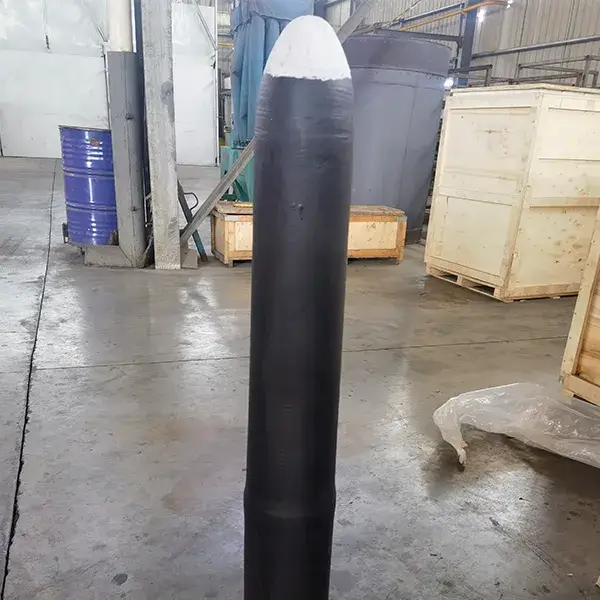
1.Monoblock Stopper
Characteristics of Monoblock Stopper Rods: Monoblock stopper rods are manufactured exclusively using isostatic pressing. Their shape and dimensions are determined by the tundish capacity, the molten steel level, and the geometry (flare shape and bore diameter) of the tundish nozzle. Stopper rod heads may feature hollow designs, argon injection ports, or embedded porous plugs. Key mounting methods include metal pin fixation and threaded connections.
The primary function of the stopper rod is to control the opening and closing of the tundish outlet. Beyond automatically regulating the flow of molten steel from the tundish to the mold, it allows for the injection of argon or other inert gases into the tundish through internal channels, thereby serving functions related to flow control and steel purification.
Monoblock stopper rods are typically made of alumina-carbon material. The head incorporates an argon injection port or an embedded porous plug; during casting, argon flows through the rod and exits via the port or plug toward the submerged entry nozzle (SEN). Dispersing the argon into the molten steel as fine bubbles helps reduce alumina (Al₂O₃) agglomeration and deposition within the SEN, ultimately extending the service life of the stopper rod.
To accommodate various refining conditions and the continuous casting requirements of different steel grades, stopper rod heads are available in materials such as alumina-carbon, magnesia-carbon, spinel-carbon, and zirconia-carbon, while the rod body is predominantly made of alumina-carbon material. For long-sequence continuous casting operations, the rod body may feature a composite design incorporating slag-line resistant material to enhance erosion resistance in that specific zone.
2.Physicochemical Properties of Alumina-Carbon Monoblock Stopper Rods
During continuous casting, the heads of monolithic stopper rods often suffer from severe erosion and scouring. This is particularly problematic when casting certain special steels—such as those treated with Ca or Si, or high-speed cutting steels alloyed with P and S—where the stopper rod head erodes too rapidly, often leading to the rod being scrapped because the molten steel flow rate can no longer be controlled. The newly developed MgO-Al2O3-C composite stopper rod utilizes fused magnesia with a CaO/SiO2 ratio greater than 2 and high-purity graphite (99% C content), along with SiC antioxidants and other additives. This design allows the rod head to fully leverage the superior erosion and thermal shock resistance of the MgO-C material, while ensuring its thermal expansion rate remains compatible with the Al2O3-C body material.
For the composite Al2O3-SiC-C stopper rod, the rod body is composed of Al2O3-C material, while the stopper head section consists of Al2O3-SiC-C material. The materials feature premium-grade bauxite (Al2O3 > 87%), fused corundum (Al2O3 > 99%), and graphite (C > 95%). Isostatic pressing is employed during manufacturing, effectively preventing interfacial fracture—caused by differing thermal stresses between the Al2O3-C and Al2O3-SiC-C materials—at high temperatures.
Monolithic stopper rods require preheating to 800–1000°C before use. However, prolonged preheating can cause the graphite on the surface of Al-C products to oxidize and become porous, thereby reducing erosion resistance and service life, and potentially leading to breakage or perforation during operation. The application of an anti-oxidation coating creates a continuous, glossy, and strongly adherent glaze layer at temperatures below 1000°C; this coating does not drip and offers excellent oxidation resistance.
Measures to prevent stopper rod clogging:
- Argon purging through the stopper rod. When casting special steels containing Ti, Ca, or Si, inclusions tend to form and cause clogging at the junction of the rod tip and the nozzle. By utilizing a porous or slit-type design at the stopper rod head, argon gas can be blown toward the submerged entry nozzle (SEN), thereby preventing clogging caused by accretion (nodulation).
- Gas purging of the long nozzle. Injecting argon gas into the top of the stopper rod’s central bore—allowing it to flow through the porous plug tip and into the casting stream—not only prevents nozzle clogging but also helps refine inclusions and reduce their size.
- Anti-clogging spinel-carbon stopper rods. Calcium-treated steel causes severe erosion of alumina-carbon materials; however, newly developed spinel-carbon stopper rods do not react with mCaO·nAl2O3 and offer high structural strength and excellent erosion resistance.
3.Long Nozzle
When molten steel is poured from the ladle into the tundish, a long nozzle is installed at the lower end of the ladle’s sliding gate mechanism to prevent oxidation and splashing; one end connects to the lower nozzle, while the other is submerged in the molten steel within the tundish to ensure sealed, protected pouring.
The functions of the long nozzle are as follows:
(1) Preventing secondary oxidation of the molten steel and improving steel quality;
(2) Reducing the deposition of oxidation products (from easily oxidized elements in the steel) on the inner walls of the nozzle, thereby extending its service life;
(3) Allowing for multiple uses, which reduces refractory material consumption.
Long nozzles should possess the following properties:
(1) Excellent thermal shock resistance;
(2) Good mechanical properties and resistance to vibration;
(3) High resistance to erosion by molten steel and slag;
(4) A gas-sealing device at the connection point. Long nozzles are generally made from two main types of materials: fused silica and alumina-carbon.
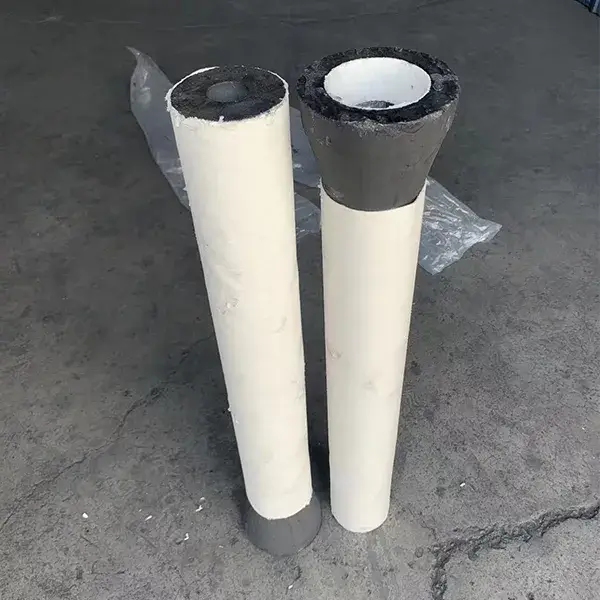
Fused silica long nozzles are formed using the slip casting method; they are characterized by good thermal shock resistance, high mechanical strength, resistance to acid slag erosion, and excellent chemical stability. However, they are prone to forming low-melting-point compounds when reacting with oxides (such as iron or manganese) found in molten steel or slag. Furthermore, at high temperatures, the silica decomposes and gasifies through reactions with carbon, resulting in poor erosion resistance and making them unsuitable for the production of clean steel.
Alumina-carbon long nozzles utilize high-purity raw materials to minimize impurities and employ optimized particle size distribution to improve microstructural integrity and erosion resistance. The natural graphite content is adjusted to leverage the non-wetting properties of coarse-grained flake graphite against molten steel, thereby reducing nozzle clogging (buildup). Molding techniques have been improved to minimize cracking, and micropowder technology—such as the addition of appropriate amounts of Al₂O₃ micropowder—is applied to enhance high-temperature strength and thermal stability. These nozzles exhibit excellent thermal shock resistance and versatility across various steel grades. To prevent the oxidation of surface carbon during preheating and operation, an anti-oxidation coating is applied. This coating, composed primarily of feldspar, quartz, and clay, is prepared as a glaze via wet milling and applied manually or mechanically; it forms a protective glaze layer within the 700–1000°C temperature range, effectively preventing or minimizing graphite oxidation.
To further enhance the performance of alumina-carbon long nozzles—beyond the incorporation of low-expansion materials (fused silica, aluminum titanate), toughening agents (zirconia), and steel fiber reinforcement—material compositions have been modified to increase Al₂O₃ content and reduce SiO₂ levels, thereby ensuring superior thermal shock resistance and extending service life.
Domestically developed “no-preheat” long nozzles can be used immediately without preheating, simplifying operational procedures and reducing energy consumption. Argon sealing is employed at the interface between the long nozzle and the ladle nozzle, effectively utilizing the long nozzle’s high-temperature, erosion-resistant, and scour-resistant properties. Additionally, chromium corundum-mullite long nozzles and monolithic long nozzles made from Al₂O₃-SiC-C castables have been developed, all demonstrating excellent performance in practical applications.
4.Submerged Entry Nozzle
In continuous casting technology, a submerged entry nozzle (SEN) is installed between the tundish and the mold to improve the quality of the cast strand. Its primary functions are:
(1) Preventing secondary oxidation and nitridation of the molten steel, as well as splashing;
(2) Regulating the flow pattern and injection velocity of the molten steel;
(3) Preventing the entrapment of mold flux and non-metallic inclusions in the molten steel, and playing a crucial role in promoting the flotation of inclusions;
(4) Having a decisive impact on the yield of the cast product and the quality of the cast strand.
The submerged entry nozzle is mounted at the bottom of the tundish and extends into the mold. Its main types include:
A Integral-type submerged entry nozzle (SEN): This type does not require a separate upper nozzle; it features an elongated profile, typically exceeding 700 mm in length. There are two configurations: the internal-mount type, installed from inside the tundish outward as a single, integral unit with excellent sealing properties; and the external-mount type, installed from the tundish bottom inward (a method not yet utilized domestically).
B Externally mounted SEN: This type operates in conjunction with a tundish upper nozzle. During operation, the upper end of the SEN is suspended from the tundish bottom via a support ring or robotic arm, connecting to the upper nozzle, while the lower end is submerged in the mold.
C Quick-change SEN: Functionally similar to the lower nozzle of a slide-gate system, this type is primarily used for slab and wide/thick slab continuous casting. It operates with a quick-change tundish upper nozzle and represents the future direction of development.
D Thin-slab SEN: Specifically designed for thin-slab continuous casting, this type is characterized by flat discharge ports and a thickness ranging from 60 to 80 mm.
Submerged entry nozzles possess a certain degree of porosity and gas permeability; consequently, under the negative pressure generated by the flow of molten steel, external air can permeate the nozzle body and oxidize the steel upon contact. Therefore, an anti-oxidation glaze coating must be applied to the outer surfaces of both long nozzles and submerged entry nozzles. Regardless of material or structural design, all submerged entry nozzles must meet the following requirements:
(1) Ensure sufficient molten steel throughput at normal casting speeds;
(2) Promote uniform heat flux distribution across the cast strand’s cross-section within the mold;
(3) Facilitate the rapid melting of mold flux;
(4) Promote the flotation of inclusions and prevent slag entrapment;
(5) Avoid violent turbulence of the molten steel surface within the mold;
(6) Allow for convenient installation.
