
Increasing the lifespan of an induction furnace, reducing the frequency of furnace maintenance, and alleviating the labor intensity of workers, thereby improving productivity and reducing production costs, has always been a focus for many induction furnace users. Furnace lifespan, also known as furnace service life, refers to the total number of heats of steel produced during the service life of an induction furnace, from the time the furnace lining is put into use until it is replaced with a new lining. It is also a comprehensive indicator for measuring the production level of an induction furnace.
1.What are the causes of damage to the lining material of an intermediate frequency furnace?
Raising the furnace lid and opening the furnace door can cause sudden temperature changes in the refractory lining, leading to spalling and cracking, and premature damage to the lining. During charging, the lining is subjected to impact and vibration when tilted, and is eroded by metal, slag, and gas flow during boiling, all of which reduce the lining material’s lifespan. Therefore, the lining material for medium-frequency furnaces must meet the following requirements:
- Sufficient refractoriness: During smelting in a medium-frequency furnace, the temperature of molten steel reaches as high as 1700℃, and the temperature of molten iron exceeds 1500℃. The lining material must be selected according to the different smelting temperatures.
- Good chemical stability;
- Good thermal shock resistance;
- High high-temperature compressive strength;
- Low thermal conductivity and low electrical conductivity.
2.Medium frequency furnace repair material
Medium frequency furnace repair refractory, also known as medium frequency furnace patching material, is a plastic repair material made primarily of high-quality alumina and using special chemical raw materials as binders. It possesses excellent anti-slag adhesion and anti-corrosion properties, exhibits superior adhesion, and is very easy to apply. It is widely used for repairing the furnace mouth, lining, operating ladle, and other industrial kilns of medium frequency induction furnaces.
The repair lining is a refractory material with excellent physical and chemical properties. After several improvements, it is now an excellent refractory material for medium frequency furnace repair. Based on our use and customer feedback and suggestions, we have summarized the usage methods for future on-site reference.
3.Neutral furnace lining material
Neutral furnace lining material belongs to the category of refractory materials used in coreless alumina induction furnaces. It is neutral in nature and features high refractoriness, a low coefficient of thermal expansion, good thermal shock resistance, and excellent slag resistance. It is currently mainly used for smelting stainless steel, high-alloy steel, low-alloy steel, carbon steel, and high-manganese steel. This material is a premixed binder dry vibrating material with a proprietary particle size distribution, allowing for direct use by the user.
4.Coil putty
The advantages of using coil insulating putty are as follows:
After drying, the coil insulating putty layer has excellent insulation properties and can completely replace mica and fiberglass cloth as the insulating protective layer between the coil and the furnace lining. The putty material has a high thermal conductivity, so there is no need to worry that a relatively thick putty layer will affect the three-layer bonding of the hot-face furnace lining.
The putty layer is located between the coil and the insulation layer. Under normal circumstances, the ambient temperature is very low (less than 300℃). Occasionally, when molten metal approaches its surface, the putty layer will release a small amount of residual moisture, reducing the insulation resistance and providing an early alarm for the system.
5.Alkaline furnace lining materials
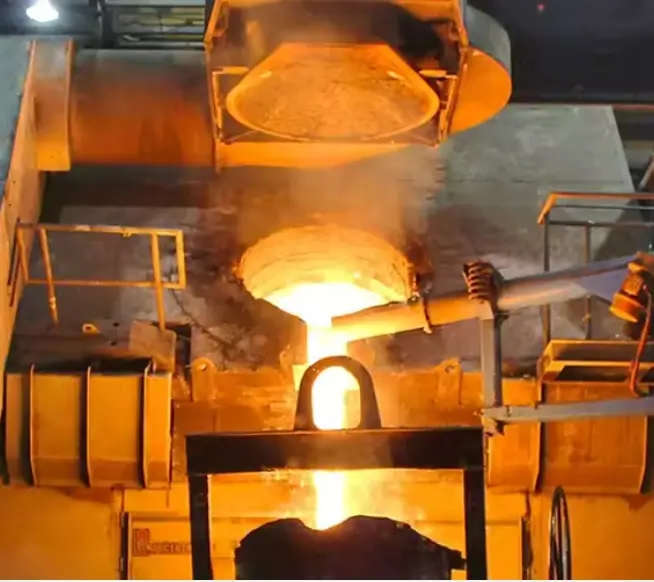
This alkaline furnace lining material is a magnesium oxide-based refractory material for coreless induction furnaces, and its material is alkaline. It can smelt carbon steel, high manganese steel, heat-resistant steel, high alloy steel, and other steel grades, and is particularly suitable for furnaces with capacities ranging from 150kg to 1000kg. This material is a pre-mixed binder dry vibratory lining with a proprietary particle size distribution, allowing for direct use by the user.
Features: Material density: 3.10g/cm² (Magnesium oxide ≥96%) Operating temperature: 1600~1700℃ (Particle size ≤6mm) Recommended applications: Carbon steel, high manganese steel, stainless steel, etc. Construction method: Dry vibration or dry tamping.
6.Ladle/Iron ladle castables and ramming materials
Shorter construction period, improving equipment turnover rate; mechanized construction, less physical labor required, more user-friendly; long service life, fewer accidents, safer; seamless, uniform lining structure, no structural weaknesses; can be repeatedly repaired and reused, reducing unit refractory consumption and minimizing the environmental impact of waste furnace lining; can be designed with low heat consumption, saving energy loss; can effectively utilize different refractory properties to construct different furnace lining materials; prefabricated components can be manufactured according to requirements and shapes.
