
Medium-frequency induction furnaces operate on the principle of electromagnetic induction, generating heat directly within the furnace charge itself to effect melting. Particularly in recent years—against the backdrop of a downturn in the metallurgical industry—these furnaces have gained widespread adoption in both the metallurgical and foundry sectors. This popularity stems from their numerous advantages: low initial investment, long service life, high electrical efficiency coupled with low specific energy consumption, ease of operation, minimal burn-off of alloying elements during smelting, reduced formation of brittle inclusions, and high metal purity. By utilizing medium-frequency furnaces for the production of rolling mill rolls—and through a process of empirical exploration and technical synthesis regarding operational best practices—it is possible to achieve extended service life, energy efficiency, high productivity, and effective accident prevention.
The longevity technology for acidic medium-frequency induction furnaces utilizes high-quality furnace lining materials.
Implement rigorous furnace construction processes
Pneumatic ramming is employed: first, the furnace bottom is rammed using a furnace bottom ramming machine; subsequently, the mold is lowered into place, and furnace-building material is introduced into the space between the mold and the insulating layer; finally, a vibrator is used to vibrate the mold, thereby compacting the material.
Continuous Oven Process
The characteristic of the baking process is a “slow temperature rise during the low-temperature stage,” and the temperature during the sintering stage is approximately 50°C to 80°C higher than the maximum tapping temperature.
Formation of the Sintered Layer
Warm sintering facilitates the formation—in the radial direction of the furnace lining, from the interior outward—of a sintered layer, a transition layer, and a loose layer, each occupying one-third of the total thickness.
Maintenance and Usage Requirements
The furnace charge must be added in small batches and small lump sizes across multiple increments; it must not be allowed to pile up excessively, thereby minimizing the impact of the charge on the furnace walls and hearth.
Measures for Protecting the Furnace Throat
By installing a circular cast-iron protective ring on the furnace rim—such that the upper surface of the final refractory layer, applied during furnace construction, sits 20–30 mm below the rim—excellent protection is provided to the furnace collar area.
Monitor furnace conditions at any time.
Strengthening routine inspections—specifically by monitoring the condition of the furnace lining for erosion and cracks, and using specialized measuring tools to gauge its overall height and diameters at various elevations—along with conducting regular maintenance, constitutes a critical factor in extending the service life of furnace lining materials.
Furnace Repair
In cases where furnace bottom corrosion is less than 50 mm, the furnace-lining material is appropriately moistened; impurities are removed from the furnace bottom, and the area is compacted using a ramming hammer to perform a “hot patch.”
Master the Timing for Furnace Shutdown and Dismantling
If horizontal annular cracks clearly visible to the naked eye appear along the circumference of the furnace wall, or if the furnace lining exhibits severe erosion and spalling—and particularly if the power and current reach or exceed 5% to 10% of their rated values, or if the agitation of the molten iron within the furnace becomes noticeably more violent than usual—then immediate shutdown and dismantling of the furnace must be considered.
Smelting Operations
During the smelting process, high-temperature smelting should be avoided whenever possible. At elevated temperatures, the reaction SiO₂ + 2C → Si + 2CO occurs; the higher the temperature and carbon content—and the lower the silicon content—the more severe the erosion of the furnace lining becomes. High-temperature smelting is strictly prohibited, particularly when the furnace is new; avoiding it is an effective strategy for extending furnace life and reducing electricity consumption.
Prevent Furnace Lining Overheating
The occurrence of “bridging” in the furnace charge leads to localized high temperatures—potentially exceeding the refractory limit of the lining—which can cause the lining to melt and erode, thereby reducing its service life.
The Impact of Molten Iron on Furnace Lining Lifespan
The stirring force generated in the molten iron under electromagnetic action erodes the furnace lining; furthermore, at high temperatures, the SiO2 within the lining is reduced by the carbon in the molten iron, thereby compromising the service life of the lining.
The Impact of Slag on Furnace Linings
The furnace charge—specifically rust and return scrap—contains slag components such as FeO; these react with the SiO2 in the furnace lining to form low-melting-point slag, the accumulation of which severely erodes the lining. Furthermore, this slag can obscure actual cracks within the lining; therefore, the timely removal of slag is a critical factor in extending the service life of the furnace lining.
Steel Raw Material Requirements
Strict measures must be taken to prevent the introduction of materials containing excessive levels of zinc (Zn) and lead (Pb). Since the melting points of these two elements are relatively lower than that of iron, they vaporize and permeate the entire furnace lining before the iron itself has fully melted, thereby leading to the formation of erosion cavities and cracks within the quartz sand lining.
Efficient Production
To achieve highly efficient production, a rational melting process must be formulated based on the metallurgical characteristics of the medium-frequency induction furnace. Strict control must be exercised over every stage—including hopper charging, temperature regulation, the addition of alloying elements, carbon raisers, and slag-forming agents at specific temperatures, as well as tapping temperature and rapid chemical analysis—with the aim of minimizing melting time, alloy burn-off, and oxidation, thereby controlling and stabilizing the metallographic structure and ultimately enhancing the quality of the rolls.
Energy-saving technologies
It is essential to scientifically manage and utilize furnace charge materials to ensure that key chemical constituents meet specifications and that the content of harmful impurity elements is minimized. This prevents delays in smelting time caused by compositional adjustments and eliminates the risk of material rejection due to non-compliant composition.
During the charging process, efforts should be made to keep the metal charge in a compact state, filling the entire furnace cavity as completely as possible. This ensures the maximization of thermal efficiency and enhances the overall melting efficiency.
Upon initiating power supply, initially apply approximately 60% of the total power output. Once the initial current surge has subsided, rapidly increase the power to its maximum level to accelerate the melting of the furnace charge.
Reasonably control tapping temperature
In the smelting process, the molten iron is heated to the required process temperature only during the 5 to 10 minutes immediately preceding pouring; for the remainder of the time, the melt is maintained at a lower temperature. This approach minimizes the erosion of the furnace lining caused by high-temperature molten iron, thereby extending the lining’s service life and reducing electricity consumption.
High-Alloy Recovery Technology
The burn-off loss of easily oxidizable elements—such as Si, Mn, and Cr—in induction furnaces typically ranges from 3% to 5%. This loss generally occurs during periods when the melt-down time is excessively long and insufficient attention has been paid to slag formation for protective coverage.
Furnace charge materials should be kept as clean as possible; they should not be branched in shape, nor should their dimensions be excessively large or thin. Bridging of the charge must be strictly avoided. During the initial stages of melting, slag should be formed promptly, ensuring that the melt remains covered by slag during the subsequent high-temperature phase. In the latter stages of melting, frequency adjustment should not be excessive; furthermore, the superheating temperature should not be raised too high, and holding the melt at high temperatures for extended periods must be strictly avoided.
Principles for Adjusting Component Order
When the temperature of the molten iron exceeds the equilibrium temperature, the reaction SiO₂ + 2C → Si + 2CO proceeds to the right, resulting in a decrease in carbon and an increase in silicon within the melt. Therefore, it is necessary to add supplemental carbon during the charge preparation stage. During the final composition adjustment phase, the additions should be made in the following sequence: manganese first, followed by carbon, and finally silicon.
Analysis of the Causes of Splashing and Explosions During Induction Furnace Smelting
Molten Iron Splashing in the Induction Furnace
Carbon-oxygen reactions and the high-temperature decomposition of iron oxides proceed continuously within the molten steel bath; furthermore, the presence of moisture and rust in the furnace charge generates a persistent outward-surging force within the molten iron, subsequently leading to splashing.
Slag crusting, molten iron eruption
When the heat dissipation rate of the molten slag exceeds the heat transfer rate of the liquid steel, a crust forms on the slag surface. This creates a sealed environment within the space beneath the slag crust; consequently, gases generated during the smelting process cannot be released in a timely manner. Once the gas pressure reaches a critical level, it ruptures the slag crust, causing the molten metal and slag to erupt—a phenomenon that can lead to major safety accidents.
Charge Bridging
The causes of charge bridging include: excessive charging in a single batch; the upper charge being packed too tightly, leading to jamming or suspension; and an irrational charge structure—specifically, small-sized lumps with high melting points in the upper section, and large-sized lumps with low melting points in the lower section. Additionally, an uneven furnace wall surface hinders the smooth descent of the charge. Once charge bridging occurs, the temperature of the molten pool in the lower section rises continuously, creating a high-temperature, high-pressure atmosphere within the furnace. This leads to severe erosion of the refractory furnace lining by the molten metal; in extreme cases, it can result in localized leakage of molten metal through the furnace shell, allowing cooling water to enter the molten pool and trigger a massive explosion.
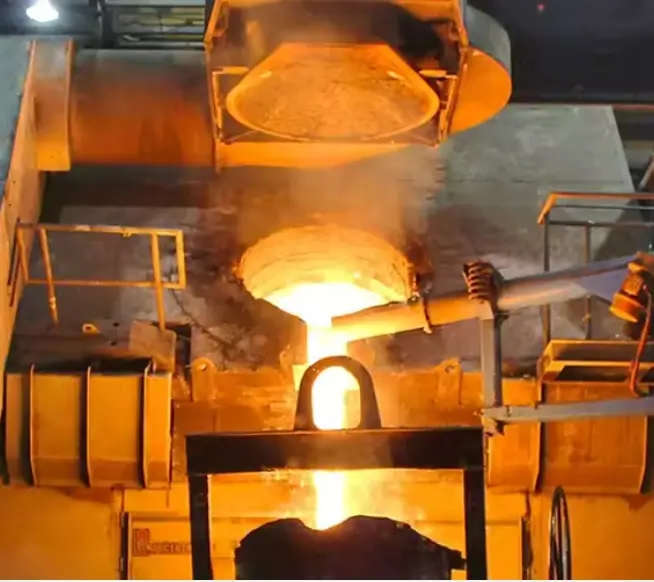
Induction Coil Leakage
Within the medium-frequency induction furnace, the electromagnetic stirring of the molten iron causes it to scour the furnace lining material, leading to accelerated erosive wear. Consequently, certain sections of the lining become severely eroded and fail; the molten iron then penetrates the furnace shell, causing a short circuit and burn-through between the two layers of induction coils. If the cooling water circulating within the coils subsequently enters the furnace interior, it can trigger an explosion.
Effect
1) Through the comprehensive implementation of the aforementioned technical and management measures, the economical operation of the medium-frequency furnace has been successfully achieved.
2) During steelmaking in the medium-frequency induction furnace, the recovery rates for both metallic charge and alloying elements have improved significantly. The recovery rate for ferrous materials can reach 97%–98%, while the recovery rate for alloying elements sees a notable increase of approximately 1%. Consequently, the cost-saving advantages regarding ferrous materials and alloys are quite substantial.
3) Adjusting the chemical composition during smelting is highly convenient, effectively meeting the process requirements for maintaining the molten iron within a narrow compositional range; this results in more stable performance for the finished rolls and lower smelting costs.
4) Characterized by a high-power supply and robust heating capabilities, the medium-frequency furnace can achieve specific temperature ranges tailored to rolls of varying materials and specifications, thereby fully satisfying the requirements of the casting process.
By strictly controlling the operational processes of medium-frequency induction furnaces and strengthening technical management, it is possible to ensure their economical and efficient operation. Further research into technologies for extending furnace service life, optimizing melting efficiency, and preventing accidents will enable better compliance with product technical specifications and facilitate more cost-effective operations.
